
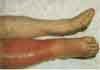
DVT is an issue among not only airline travelers but potentially all those who sit immobile for extended periods of time according to the World Health Organization.
DVT (aka VTE, venous thromboembolism) occurs when blood platelets stick together and form clots which either block local circulation or break away to lodge in other organs such as lungs (Embolism) brain (Stroke) or heart (Heart Attack). DVT is an issue among not only airline travelers, but potentially all those who sit immobile for extended periods of time (4 hours or more) according to WHO (World Health Organization). The use of birth control pills and those with blood abnormalities, such as a tendency for easy clotting, have also an increased risk.
Although a recent WHO report suggests that only 1 in 6000 are affected, other studies indicate that it is much more prevalent. One 30 year study reported that DVT may affect as many as 1 in 20. Two thirds of patients with proven pulmonary embolism have no symptoms, and one third of the time it is impossible to find the original site of a DVT without an autopsy. Nevertheless, massive pulmonary embolism (essentially the same as DVT) causes 200,000 deaths annually in the United States; this is a silent killer and combined with the low rate of autopsy in the United States, the real numbers of deaths directly associated with DVT/VTE remain hidden.
Common medical treatment or prevention strategies include the use of blood thinners such as warfarin or heparin. Many people take aspirin before plane flights to protect themselves from DVT – mistakenly. While aspirin is helpful in prevention of arterial thrombosis, it is almost totally useless when it comes to preventing blood clots in veins.
There are better alternatives. In addition to the standard recommendations to hydrate during long trips, wear support stockings, and to get up and walk around periodically, proteolytic enzymes offer an attractive option. Systemic formulas that incorporate nattokinase and seaprose s help regulate the blood clotting cascade, normalizing the function of this vital defense mechanism. They work not so much as a blood thinner, but as a corrector of blood chemistry and function. They are safe, and non-toxic which is more than what can be said for warfarin (Rat Poison).
As a final thought, it should be safe for us to sit for 3 to 6 hours without risking our lives due to DVT. It’s a sad commentary on our dietary and lifestyle choices that so many of us render our bodies incapable of handling such a simple task. At least there’s a safer option than rat poison for those at risk.








i am really scared please help i have varicose veins and in my upper thigh i have a “sac’ I ALSO THINK I HAVE DVT. i am very itchy there and it is dry is this life threating? i saw a vein specialist but i do not think i should wait for the ultrasound.
please help me i think i might have dvt. i have a sac like looking thing under my legs is this life threating?
i have a dvt i have had it
i have a dvt i have had it for 7 months and i also got the varicose veins in my leg and the itching drives me mad doesnt matter how much cream i put on to soften it it doesnt work i think u should go for a ultrasound cos the longer you leave it the worse it will be if u do have a dvt then if u do have one the docters will treat you like me i am on warfin and injections called enoproxin to keep my inr levels normal but i really think u should get it checked u never no u might be lucky and not have one GOOD LUCK.
Warning: There could be a
Warning: There could be a problem taking high doses of certain proteolytic enzymes on an empty stomach before bedtime. The enzymes could start digesting the lining of your intestines during a time of slower gut function when asleep.
Unless you have an ulcer that
Unless you have an ulcer that has exposed part of your stomach and duodenum to direct action by acid and enzymes, your entire intestinal tract is covered with a mucous lining that protects it against enzymes and acids. If not, your stomach would be eaten up by the pepsin and HCL it secretes and your intestines would be eaten up by the highly concentrated proteolytic enzymes released by your pancreas. And in fact, millions of people have supplemented with proteolytic enzymes of all different brands on an empty stomach before bed for at least the last decade, and there has been no credible evidence of any notable connection between using proteolytic enzymes and harming your intestinal tract. But as always,when starting any new supplement program, and as Jon Barron always recommends, start with a very low dose and build over time. Hope that helps.
I fly a lot because of my job
I fly a lot because of my job and I frequently experienced swollen ankles. After speaking with my doctor he recommended compression hosiery. Sigvaris and Jobst were my first options but then I couldn’t get over the boring ‘old lady’ colors. I tried a pair of Nike soccer socks and read as much as I can from mayoclinic.org and compressionpoint.com to help me manage my daily symptoms when travelling.