
Every woman between the ages of 13 and 117 needs to seriously consider supplementation with a natural progesterone creme.
Every woman between the ages of 13 and 117 needs to seriously consider supplementation with a natural progesterone creme.
Why? Because virtually every woman who lives in an industrialized country (the United States, in particular) is at high risk of estrogen dominance because of exposure to xenoestrogens. Xeno- estrogens, which are mostly petroleum based synthetic estrogens, are now present in massive amounts in our food chain, water supply, and environment.
At one time, our diets afforded some protection. Fruits and grains and vegetables (in their natural state) provide low-action phytoestrogens for the body. These low-action estrogens fill the body’s estrogen receptor sites — making them unavailable for use by the more potent estrogens — both natural and synthetic. Unfortunately, today’s diets are dominated by processed foods, which are stripped of these beneficial phytoestrogens. The net result is that virtually all of the body’s receptor sites are ready and waiting for the far more intense estrogens.
Some high potency estrogens (such as estrone and estradiol) are produced by the body itself. But far and away, the greatest problem comes from the powerful and destructive petrochemical-based xenoestrogens. Not only are these xenoestrogens omnipresent, they are considerably more potent than estrogen made by the ovaries — some even potent in amounts as small as a billionth of a gram.
Before we proceed, it is important to understand what role estrogen plays in the body. In addition to promoting the growth of female characteristics at puberty, the estrogen hormones also promote cell growth. It is the estrogens, for example, that stimulate the buildup of tissue and blood in the uterus at the start of the menstrual cycle. The problem comes when high levels of estrogen (natural and synthetic) are unopposed by sufficient amounts of natural progesterone, which leads to continuous, unrestrained cell stimulation. Problems that can occur include:
- Excess estrogen is the only known cause of endometrial cancer
- Increased risk of breast cancer
- Loss of bone mass
- Increased risk of autoimmune disorders such as lupus
- Fibrocystic breasts
- Fibroid tumors
- Depression and irritability
- PMS symptoms such as cramping and bloating — in addition to depression and irritability
- Menopausal symptoms such as hot flashes and night sweats — again, in addition to depression and irritability
- Decreased sex drive
- Increased body hair and thinning of scalp hair
- Migraine headaches
- Impaired thyroid function, including Grave’s disease
- Increased body fat
- Increased blood clotting
- Impaired blood sugar control
- The astounding acceleration of puberty in young girls from an average age of 14 to 15, to now as young as 9 or 10. (This represents a speed up of as much as 1/3 sooner in their lives and has frightening implications for long term health.)
- And, finally, xenoestrogens have been strongly implicated in declining male sperm production and the increase in the rates of testicular cancer and prostate cancer
The Answer: Balance Estrogen
The only natural balancer to excessive estrogen in the body is natural progesterone — not more estrogen. But what about the synthetic “progesterones” (such as Provera) that your doctor recommends? Progesterone is a natural substance, and as such cannot be patented. The pharmaceutical companies, therefore, have to modify it slightly. They literally create a new molecule, called medroxyprogesterone — that does not exist in nature — in order to take out a patent. This “slightly” modified artificial progesterone is what most doctors prescribe. What effect does slight modification have?
Consider the fact that the testosterone molecule and the estrone molecule are virtually identical — except for the fact that the positions of the oxygen atom and the OH atoms change places. This slight “modification,” however, happens to be enough so that one hormone makes men…and the other women.
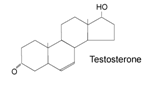
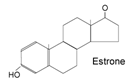
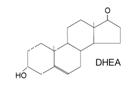
Even closer is the similarity between DHEA and estrone. The molecules are actually identical except for the location of some of the double bonds between carbon atoms. You cannot get closer. And yet the function of DHEA and estrone could not be more different.
And now look at the difference between natural progesterone and Provera:
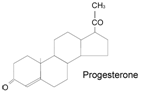
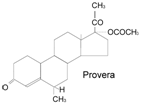
The bottom line is that Provera is not natural. It’s a synthetic form of progesterone that carries a whole range of serious side effects. A small sampling of these side effects, as listed in the Physician’s Desk Reference, includes:
- Depression
- Birth defects
- Increased body hair
- Acne
- Risk of embolism
- Decreased glucose tolerance
- And allergic reactions
Now, in exchange for these significant side effects, Provera does offer some protection against endometrial cancer and a very modest increase in bone formation.
On the other hand, supplementation with natural progesterone has NO known side effects. It is best utilized by the body when administered transdermally with a skin creme that contains approximately 500 milligrams per ounce of natural progesterone and offers the following potential health benefits
According to Dr. John R. Lee, the author of What Your Doctor May Not Tell You About Menopause, natural progesterone may significantly improve bone formation — by as much as 15% – 35%. (Understand, this is unique to natural progesterone. Estrogen supplementation does not increase bone formation; it merely slows the rate of loss for a 5-year period around the time of menopause. And man-made progestin only mildly increases bone formation. If you are worried about osteoporosis, there is only one substance known that significantly improves bone formation — and that’s natural progesterone.)
- Increased progesterone levels in the body may help to protect against endometrial cancer
- They may also help protect against breast cancer
- In addition, supplementation with natural progesterone can help relieve symptoms of PMS
- Relieve symptoms of menopause
- Normalize libido
- Improve the body fat profile
- Improve sleep patterns
- And help relieve migraine headaches
The bottom line is that every woman living in the industrialized world should seriously consider supplementation with natural progesterone.
-
If you decide to begin a regimen of natural progesterone supplementation, look for a premium quality balancing creme that contains a minimum of 500 milligrams per ounce (the amount recommended by Dr. Lee) of 100% pure, USP grade progesterone, naturally derived from either wild yam or soybeans. Look for a natural vegetarian formula that uses no artificial or synthetically derived fragrances, parabens or preservatives. Look for a formula that uses all natural oils and an enhanced liposome delivery system to help move the progesterone through the skin. And finally, look for a formula that uses organic wild yam…if you can find it. It’s getting harder and harder to find companies that use it.
Whether you’re still going through your menstrual cycles (or whether you’re pre-menopausal, or menopausal, or post-menopausal), you need to seriously consider supplementation. The benefits are extraordinary; the risks virtually non-existent. And the risks of not supplementing potentially include: an increased risk of breast cancer, endometrial cancer, and osteoporosis — to reiterate just a few. (And for men, natural progesterone can help with depression and can help relieve prostate problems.)






Concern about natural progesterone cream
Dr. Mercola wrote an article which says natural progesterone cream builds up in bodyfat tissue over time and after a period of time, the cream stops working. I assume the more bodyfat a woman has, the greater the problem will become. Here is the link to his article http://www.mercola.com/article/progesterone/cream.htm In another article by Dr. Mercola, he says “Sublingual[Progesterone] drops offer the best of both worlds, as it enters your blood stream directly and will not build up in your tissues like the cream can…” http://articles.mercola.com/sites/articles/archive/2009/12/26/This-Natural-Hormone-Can-Help-Heal-Your-Brain-Injury.aspx I’d sincerely appreciate a response to this, as I’ve noticed you’ve replied to articles written by Dr. Mercola in the past.
The advantage of drops is
The advantage of drops is that they reach the bloodstream more quickly with a cream. The disadvantage of drops is that they reach the bloodstream all at once, causing spikes in your progesterone levels, whereas the progesterone in a transdermal cream is measured out into the bloodstream in a more continual – even basis. As to it not working if it builds up in the fat tissue, that’s not correct. It means that you won’t absorb any more into your fat cells when applied transdermally…until, that is, the progesterone already in your fat cells makes its way into your bloodstream. In effect, it’s a self-regulating system.
I have had lots of experience
I have had lots of experience with hormones, I just turned 74 on Dec. 8,2015 and I stared on Estradiol, and prometrium
Both are made from soy and yams, prescription only
They are estrogen and progesterone and I started at the age of 45 and that is going to soon be 30 years, I go to the Gym at least 5 days a week and eat mostly vegetable’s organic, and occasional fish, chicken, only grass beef occasionally
I feel great, and constantly am being told I look 45 and even younger
If you want lasting results, oral by mouth works, and I have tried the over the counter creams and they work okay at first, maybe about 3 months
Also I have tried the creams by compounding pharmacies and the same thing , after a few months they do not work any more, and I am telling all women if you want look much younger feel great, have beautiful skin, go by mouth , that works as I have been doing this a long time
I look good, I look Young and I will take my hormones forever
Think about it, when you are young you have all your hormones and hardly hear of younger women getting breast cancer, because they have all there hormones, as you get older your skin starts to sag and you start aging and your neck is sagging and you are not walking strong and tall, and have the confidence you had when you looked good and your skin was tight
Every one ask me what is your secret
I tell them, hormones, organic diet, at least 64 ounces a day of water
Exercise, strength training walk an hour a day
Estrogen Protects women, that is why we live longer than men and it protects your heart
I take about 25 or more supplements a day
I could say a lot more but for now enough
The hard part is getting your dose just right
start out low, as 0.5 estradiol, and 100 mg of Name brand Progesterone
You will have to convince your doctor for a prescription, because they are so scared of breast cancer, and then you would have to find a doctor that specializes in hormones
The estradiol and progesterone protects you from cancer and so many other benefits, do some research on your own
That Nurse’s study, was a flawed study for the hormones,
as it was done with Provera, synthetic progesterone
and the estrogen was done with Premarin, made from pregnant mares urine
Vivian
,
Progesterone Creme
Hi there
could Progesterone Creme benefit my daughter who is 20 years old with grave disease, if yes, what is the instruction to use?
thank you
Can you please recommend a
Can you please recommend a brand that entails all that you suggest we look for?
Many thanks,
A
Just click on "Products"
Just click on “Products” above and see our list of recommended products and where you can buy!
Where can I buy this product
Where can I buy this product hormonal-balancing-progesterone creme
The creme
See my reply to the same
See my reply to the same question above.
Arbonne is a health and
Arbonne is a health and wellness company with 31 years of being
plant based and Vegan Certified. The FDA does not regulate anyones
skin care or wellness products – not even ours; however, Vegan Certification is huge and a fabulous “watch dog” to guarantee not
only do we not test on animals but we have NO animal by-products – ie
lanolin (from sheep).
Our phyto-prolief is what is discribed in this article…only $34 in a
pump container…very impressive. Please contact me.
Kerry Blankenship, Regional Vice President
Arbonne International
Is it possible to use
Is it possible to use progesterone after having breast cancer Mike
It depends on the type of
It depends on the type of breast cancer. Is it estrogen or progesterone driven? In either case, you would want to check with the oncologist.
2 questions: Where in the
2 questions: Where in the body should be applied? and will it help to hair loss?
Hi Demeter,
Depending on the
Hi Demeter, Depending on the product you use, I would just check the manufacturer’s instructions on where to apply the cream.
Have you seen cases where
Have you seen cases where balancing creams have been used on pre-teen girls as young as 10?
Yes we have, but we would
Yes we have, but we would recommend that it only be done with the permission and guidance of the girl’s pediatrician.
What happened when you gave
What happened when you gave your 10 yr old the bal cream? My 10 yr old had her 1st period for 2 wks now.
Is progesterone cream (or
Is progesterone cream (or drops) safe for nursing mothers?
For obvious legal reasons, we
For obvious legal reasons, we cannot diagnose or prescribe for specific conditions – merely provide information. Check with your physician. You might also find this newsletter useful. http://www.jonbarron.org/detox/dietary-supplements-preconception-pregnancy-post-partum
I have been enjoying the
I have been enjoying the natural progesterone in Progessence Plus Serum, an essential oil mix of P4 with DHEA and other essential oils. I’m curious if you have any experience with this product or feedback?
Is the generic version of
Is the generic version of Estrace, Estradiol safe?
Does one need a prescription for Natural Progeserone?
Jon, I have a friend who is
Jon, I have a friend who is TS (transsexual-MaleToFemale) that use HRT to transition. Does this affect them as it does genetic females?
I want cure ovarian cyst and
I want cure ovarian cyst and my balance my hormone.
Is this progesterone cream
Is this progesterone cream ‘bio-identical’?
My little girl is not quite 4
My little girl is not quite 4 with suspected estrogen dominance. Have children this young ever used progesterone cream before?
Yes we have seen this before,
Yes we have seen this before, but we would recommend that it only be done with the permission and guidance of the girl’s pediatrician.
Hello I am 17 and have
Hello I am 17 and have excessive hair and dandruff and excessive acne my doctor just put me on birth control pills and thats it and the hair is worse as well as acne is progesterone cream good for girls with pcos? will it help ? please answer and ThankYou
You might want to check out
You might want to check out this newsletter in which Jon discusses PCOS about 1/3 of the way into it. http://www.jonbarron.org/article/supplements-preconception#.U9Ax6NEnKbg
one truly needs a full blood
one truly needs a full blood workup before introducing hormones into one’s body. Just taking “progesterone” without knowing how much is required by your own body is foolish. Improper balance of hormones introduced into the body can have detrimental effects including suggestion to breast cancer or stroke. Always wise to know if you body needs it before you add something. this goes for all supplementation as well. Cleansing is a wonderful idea and I subscribe to that. I am cautious of taking handfuls of “pills” until I see where my bloodwork stands.
Yes, testing is certainly
Yes, testing is certainly good, but:
No one is recommending that you take hormone “pills.” The recommendation is that you use a topical crème containing natural progesterone that is absorbed into the fat cells underlying your skin, from where it is slowly released into your bloodstream.
Also, do you eat any soy beans or soy-based food products? They are high in phytoestrogens. Incidentally, phytoestrogens are also found in other legumes, namely kidney beans, chickpeas, peas, lentils and peanuts. Additionally, isoflavone phytoestrogens can be found in food sources such as wheat bran, barley, red cabbage, broccoli, black and green tea and the herb red clover. Do you eat any of those? To be consistent, you would want to test your hormone levels before eating any of these foods too. And I’m not even going to mention conventionally raised animal or dairy products or unfiltered water, as I’m guess you don’t consume those. But for those who do, they are also high sources of chemical estrogens.
Testing is certainly good. But to put it simply, our environment has been loaded with chemical estrogens. The vast majority of people on the planet are more likely to suffer from exposure to chemical estrogens than be hormonally balanced.
Testing is good. But if you don’t test, natural progesterone crème is probably a good bet.
If i am taking womens formula
If i am taking womens formula do i need a progesterone cream?
They are two different things
They are two different things. The Women’s Formula works to balance out testosterone. A progesterone cream works to balance out exposure to chemical estrogens.
PROGESTERONE CREAM
PROGESTERONE CREAM
After reading an some of your articles on Progesterone cream I tried to order some from your company for my grown daughter but discovered that you didn’t carry it. I was told by baseline nutritionals to order it from a company called KOKORU. When she received the cream, this was written on the label
……..MAY CAUSE CANCER…Can I get some explanation about this???
Thank you State of California
Thank you State of California for unnecessarily spreading fear and uncertainty! This link will answer all your questions about progesterone crème in general and Kokoro in particular. http://balance-your-body-naturally.com/user/files/Prop65_ProgesteroneCancerWarning.pdf
Incidentally, just for some perspective, every coffee shop in California posts the same warning. For more on the real story behind Prop 65, check out: https://jonbarron.org/dietary-supplements/attorney-general-war-against-supplements
I had a total hysterectomy at
I had a total hysterectomy at the age of 33 due to a couple of decades of continual ovarian cysts, miscarriages and a failed ivf treatment. The final cyst rupturing my remaining ovary and causing 300mls of free fluid to enter up into my right upper quadrant. After that I was put onto a femtran patch (50 which is just estrogen) weekly, due to not being able to tolerate Premarin orally (migraines etc)
I also should mention that I had SLE diagnosed at the age of 23, although going by my past history the Dr presumed that I had it for at least 10 years, so have always struggled with chronic fatigue and the joint/muscle problems etc that go along with Systemic Lupus.
Now aged 59, in the last 6 years I firstly had late onset type 1 diabetes diagnosed ..insulin dependant, hypothyroidism, hyponatremia which has been as low as 117, and fibromyalgia.
I have absolutely zero energy now, and have been left with just what seems to be an ever increasing fatigue physically, mentally and emotionally. I seem to sleep more often than I’m awake and feel now that I have more in common with my 87 year old mother in law than my peers. Yes, I have had depression over the years, on and off but at present, have been feeling relatively steady for sometime. The only negative emotional feelings I have are of isolation, disappointment and utter frustration!
Sorry about this being so long winded but I’m now wondering about progesterone and whether it may or may not help me return to the person that in some way resembles my former self, health wise and especially fitness and energy wise.
Many thanks for hanging in there and kind regards to all.
Amanda.
For obvious legal reasons, we
For obvious legal reasons, we cannot diagnose or prescribe for specific medical conditions—merely provide information. With that in mind, you might want to reread the above article again as it should answer many of your questions. You also might want to read the section on immunomodulators in the following article https://jonbarron.org/blood-cleansing/anatomy-and-physiology-immune-system-part-4.
I started having premenopause
I started having premenopause symptoms when I turned 46, a few months before my 47th birthday, I got new and some intense symptoms, like extreme dizziness, heart palpitations, anxiety attacks and severe nausea (like morning sickness), and migraines. I found a woman’s forum that talked about Dr. Lee’s book “What your doctor may not tell you about Premenopause” and it has made such a positive impact on my health. I take the cream daily and I do still have some symptoms but they are very minimal and liveable, when my pre menopause symptoms started I was so depressed because I thought what a horrible way to transition into this next part of my life but now I’m enjoying this transition.
What about Prometrium for
What about Prometrium for progesterone?
Please review Dr Lee ‘s
Please review Dr Lee ‘s original study. It is terribly flawed with no control group, most of the ladies were on estrogen, and his results are physiologically impossible. Many have tried and failed to reproduce his results.
We do a disservice to our oatients and our reputations to keep using his debunked study.
Natural P is wonderful for many things but the bone density information is totally wrong and dangerous. Estrogen and T increase bone density as well as DHEA.
Do your own basic research sir, it won’t take you long at all. It’s a travesty that this falsehood has taken hold in our community