
Does Oil Pulling Detox The Body?
 I think the first time I became aware of oil pulling was back in 2004, when people began writing into the Foundation asking what I thought of the technique. Suddenly, this “ancient” technique was the latest in “detoxing” protocols sweeping the alternative health community. Being somewhat knowledgeable about detoxing, I had a fundamental problem with the theory behind oil pulling as it was presented, but found the testimonials on its behalf more than a little intriguing. My response at the time was not to dismiss it, but to put it on the back burner until it sorted itself out.
And now, some seven years later, I think my original read on the technique was correct. It definitely works, but the original explanation as a detox technique that “pulls” toxins out through the mouth is probably not correct. So, with that said, let’s take a look at oil pulling: what it is, how you do it, how it works, its benefits, and finally, some recommendations on how to potentially enhance it.
What is oil pulling?
The basic technique is simple. Upon waking, you take one tablespoon of sesame or sunflower oil in your mouth and swish it around. Then spit it out. The details, however, are a little more involved.
- You need to do it first thing in the morning, before you eat or drink anything.
- You need to swish for 20 minutes — give or take maybe three to five minutes. As it turns out, this is absolutely essential for the procedure to work. If you swish for much less than 20 minutes, it won’t work. If you swish for much longer than 20 minutes, you run the risk of reabsorbing the bacteria and toxins back into your body.
- Effectively, you want to swish until the oil turns from clear and thick to a thin, white, milky consistency.
- You want to swish the oil back and forth between all of your teeth and side to side across all of your gums. You want to hit the cheeks and soft palate. Like butter on an English muffin, you want to “press” the oil into all the nooks and crannies of your mouth — over and over again.
- Do not gargle with the oil. You do not want to risk swallowing it. Swallowing a little will not harm you, but repeatedly swallowing the oil after you’ve swished with it means you will be ingesting things that you’re trying to get rid of.
- Once done swishing, spit the oil out into the toilet or sink.
- Rinse, gargle, and spit out again
- Use a tongue scraper to remove the coating from your tongue.
- Finish by brushing your teeth and rinsing with a mouthwash if you like.
- Perform daily for approximately 40-50 days (three 8-ounce bottles of oil will do the trick), then as desired.
Where does oil pulling come from?
As it was originally presented to me seven years ago, oil pulling was an ancient Ayurvedic technique for detoxing that had been “rediscovered.” It was effected by swishing vegetable oil around in your mouth to “pull” all manner of toxins out of your body and into the oil in your mouth, whereupon you then spat those toxins out. Or to quote from the Indian Journal of Dental Research, “It is claimed that the swishing activates enzymes and draws toxins out of the blood. The oil should not be swallowed as it contains bacteria and toxins.”1 As I said earlier, I had several problems with this description/explanation.
 First, I wasn’t all that convinced about its ancient Ayurvedic roots. Supposedly, it is mentioned in the Ayurvedic text, the Charaka Samhita, but whether or not you actually find it there, seems to depend on the translation you read. In some translations, it seems to refer to simple gargling. Then again, how ancient it is doesn’t really matter. While it is true that there are many things that are old that are marvelously wise (like meditation and deep prayer), there are also many things that are very old that aren’t so nice (like human sacrifice). The age of a healing technique matters not at all. All that matters is whether it works or not.
On the other hand, everything I knew about detoxing (which is quite a bit) had a problem with the concept of oil pulling as a detoxing technique. Detoxing tends to be specialized. That is to say, it takes different techniques to detox different organs. For example, you use a different technique to cleanse the liver and blood than you do for cleaning out the intestinal tract. And you use a different technique for cleaning out the kidneys than you do for removing heavy metals. Nevertheless, there are a couple of techniques that serve as general detoxifiers (saunas and cold sheet treatments2), but these make use of the entire surface area of the skin and take substantially longer than 20 minutes. I just couldn’t accept the fact that oil pulling actually worked by detoxifying the body.
As for “activating enzymes,” I had no idea what that even meant!
And yet, there was a substantial body of testimonials that indicated it absolutely was doing something to improve health. True there are no significant studies to support most of the claims, but let’s put studies in perspective for a moment. They are not all they are cracked up to be. As I’ve explained many times before, studies as designed by the medical community, which are subtractive by nature, don’t work well when it comes to multi-faceted, additive, alternative health programs. And for that matter, they don’t work all that well when it comes to medical matters either — frequently producing flawed and/or contradictory results. Indeed, medicine as a whole is much less scientific than you might think.
In any case, since I first became aware of oil pulling, the technique has amassed a pretty impressive list of testimonials on its behalf. And yes, I realize that just because you have smoke, it doesn’t necessarily mean you have fire. Sometimes it really is just smoke. Nevertheless, if you have smoke, it’s probably worth taking a look, just to be sure the house doesn’t burn down. So let’s take a look at some of the benefits attributed to oil pulling.
Reported Health Benefits of Oil Pulling
According to an article on the Earth Clinic website3, Oil Pulling is reported to cure: “Mouth & Gum Disease; Stiff Joints; Allergies; Asthma; High Blood Sugar; Constipation; Migraines; Bronchitis; Eczema; Heart, Kidney, Lung Diseases; Leukemia; Arthritis; Meningitis; Insomnia; Menopause (hormonal issues); Cancer; AIDS; Chronic Infections; Varicose Veins; High Blood Pressure; Diabetes; Polio; Cracked Heels.”
Or as Dr. Karach, one of the biggest proponents of oil pulling says, “The Oil-therapy heals totally headaches, bronchitis, tooth pain, thrombosis, eczema, ulcers, intestinal diseases, heart and kidney diseases, encephalitis and woman’s diseases. Preventively the growth of malignant tumors is cut and healed. Chronic blood diseases, paralysis, diseases of nerves, stomach, lungs and liver and sleeplessness are cured.”4
Now that’s an impressive list. And interestingly enough, there may be some truth to it — sort of. In fact, most of the benefits of oil pulling may actually be indirect results from the one benefit that it probably is truly responsible for: eliminating mouth and gum disease.
Oil Pulling To Reduce Gingivitis and Periodontal Disease
At any given time, there are more than 500 species of bacteria in your mouth — some beneficial, some harmful. It is these bacteria that form the sticky, colorless film on your teeth known as plaque, the “gateway” to many health problems. When mineral salts in saliva combine with plaque, hard deposits known as tartar or calculus, which can’t be removed by brushing alone, are formed on your teeth. Plaque can build up at your gum line, where even more bacteria can accumulate in the space between your gums and teeth. Toxins produced by the bacteria in plaque irritate your gums and cause them to become inflamed and bleed (a condition called gingivitis). This causes your gums to separate from your teeth, forming spaces between your teeth and gums (pockets) that become infected.
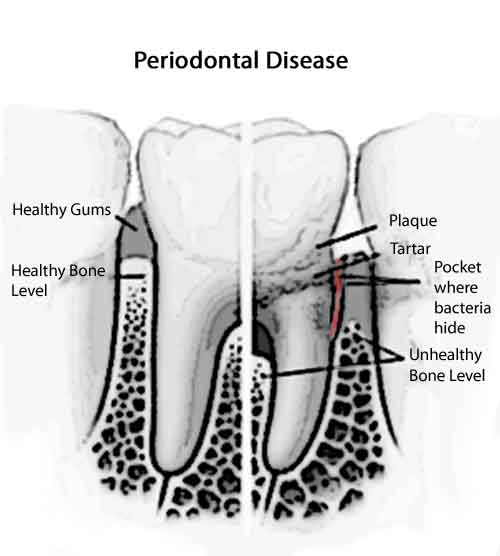
The toxins produced by the bacteria and the infection in these pockets can also stimulate a chronic inflammatory response in which your body turns on itself and the tissues and bone that support the teeth are broken down and destroyed. As the disease progresses, the pockets deepen, the inflammation and infection increase, and more gum tissue and bone are destroyed. This is called periodontitis.
In periodontitis, the connection between the teeth, gums, and jawbone is broken down — in fact, your jawbone and the ligaments that hold your teeth to your jawbone are literally eaten away. If you think this is something you don’t need to worry about, think again! Often, this destructive process has very mild symptoms (at first), so that many people are unaware that they suffer from it. About 75 percent of Americans have gum disease and don’t know it! The bottom line is that periodontitis results in loosening of the gums from the teeth, and eventually loosening of the teeth from the jawbone — not to mention bad breath and an increasing risk of life-threatening chronic illnesses, including:
- Rheumatoid arthritis
- Respiratory illness
- Diabetes
- Alzheimer’s
- Heart Disease
How can bacteria in the mouth impact so many other diseases in the body? First, once the bacteria have a sheltered breeding ground in the pockets that appear around your teeth, they can proliferate exponentially. They can then easily migrate throughout the rest of your body. In fact, simple testing of most people’s saliva will show the presence of these bacteria. Considering how many times a day you swallow saliva, it’s not hard to imagine where those bacteria can then travel. But perhaps even more important are the exotoxins and endotoxins that the bacteria produce as a simple byproduct of their very existence. It is these toxins, which cannot be destroyed by stomach acids or easily neutralized by your body’s immune system, that present the bigger problem. In fact, these toxins don’t even need to pass through your intestinal tract. Many are absorbed sublingually through the capillaries in your mouth, directly into your bloodstream. In effect, these toxins are the equivalent of being hooked up to an IV that is directly feeding low levels of poison into your bloodstream 24/7.
- Exotoxins are toxins that are excreted by living bacteria or released upon the death of bacteria. They are highly potent and can damage or even kill your body by disrupting normal cellular metabolism. Probably the best known exotoxin is the botulinum toxin, which is an excretion produced by the Clostridium botulinum bacteria as part of its normal metabolism. It’s the toxic excretion that kills you, not the bacterium itself.
- Endotoxins, on the other hand, are structural molecules of the bacterium, usually found in its outer membrane, that are recognized as threats by your immune system. The primary endotoxin is lipopolysaccharide, or LPS, which triggers your immune system to release pro-inflammatory markers that can be so extreme that they lead to “endotoxic shock.” Even a small amount of endotoxin will cause illness in humans; thus we can see the danger in harboring exponentially proflierating colonies of harmful bacteria in the mouth — and the consequent health advantages in eliminating them.
 To summarize: any bacterial infection in the mouth can easily spread throughout the entire body. Each time you swallow, more and more bacteria get to enter your digestive tract and potentially enter your bloodstream, as do their exotoxins and endotoxins which are released in your mouth. And if you manage to avoid swallowing hundreds of times a day by instead spitting repeatedly in a spittoon, you’re still absorbing the toxins sublingually 24/7. All of this leads to a never-ending, low-grade infection throughout your body, not to mention never-ending, low-grade systemic inflammation. If nothing else, this taxes your immune system, leaving it less able to deal with other infectious threats as they come along.
Once you understand this, it is easy to see that if you kill the bacteria in the dental pockets and stop the flow of poison into your body, miraculous improvements in health are a distinct possibility. This would have nothing to do with detoxing. It would simply be the result of killing the harmful bacteria that are protected from your normal everyday dental hygiene.
The key here is that most of things that you normally do as part of daily oral hygiene cannot reach the bacteria buried in pockets. Brushing and flossing won’t do it. Rinsing with a mouth wash, even one with antibacterial agents won’t do it. And applying healing gels to the gum line won’t do it. Only a water flossing device that applies a stream of water under pressure, if used properly, has a chance to flush out the buried bacteria. In other words, only a water-flossing device has any chance of eliminating the bacteria once they establish in the pockets. But here’s where oil pulling comes in. It seems that oil pulling, too, may do the job — and perhaps even better than water irrigation.
How oil pulling really works
There are several reasons that oil pulling is likely to be highly effective in killing the bacteria in your gum pockets.
- Most oils have antibacterial properties. Studies have been done on both sesame oil and sunflower seed oil that demonstrate their ability to kill bacteria. In addition, some oils, such as sesame oil also have anti-inflammatory properties.5
- The fact that oil pulling sessions run 20 minutes is crucial. It allows time for the oil to “seep” into the pockets. Unlike brushing, which only lasts a couple of minutes, or using a mouthwash, which lasts a few seconds, the extended time of the procedure keeps the antibacterial agent in the mouth long enough to work its way down into the protected pockets and reach the harmful bacteria where they live.
- Oil is, to put it simply, oily. It does what oil does. Unlike toothpaste which only goes where it’s brushed, oil seeps into the nooks and crannies of your gums.
- The aggressive swishing and pushing of the oil back and forth across the gums aids in pressing the oil down into the pockets. Again, doing this for 20 minutes allows the oil to penetrate deep into the pockets.
The bottom line, though, is that if this is true, we should see signs that bacteria really are being killed in the mouth when oil pulling is practiced conscientiously. And in fact, there are indeed a handful of studies that support this contention.
- HV Amith, Anil V Ankola, L Nagesh. Effect of Oil Pulling on Plaque and Gingivitis. Journal of Oral Health & Community Dentistry: 2007 ;1(1):Pages 12-18 http://www.johcd.org/pdf/Effect_of_Oil_Pulling_on_Plaque_and_Gingivitis.pdf
- S Asokan, J Rathan, MS Muthu, PV Rathna, P Emmadi, Raghuraman, Chamundeswari. Effect of oil pulling on Streptococcus mutans count in plaque and saliva using Dentocult SM Strip mutans test: a randomized, controlled, triple-blind study. Journal of the Indian Society of Pedodontics & Preventive Dentistry. 26(1):12-7, 2008 Mar. < http://www.jisppd.com/article.asp?issn=0970-4388;year=2008;volume=26;issue=1;spage=12;epage=17;aulast=Asokan >
- TD Anand, C Pothiraj, RM Gopinath, et al. Effect of oil-pulling on dental caries causing bacteria. African Journal of Microbiology Research, Vol 2:3 pp 63-66, MAR 2008. < TD Anand, C Pothiraj, RM Gopinath, et al. Effect of oil-pulling on dental caries causing bacteria>
Oil Pulling Recommendations
Given what we now know about oil pulling, it might be better to refer to it by its less common name, oil swishing, since there probably is no “pulling” of toxins from the body involved. On the other hand, it requires only a little bit of a stretch to say that it does “pull” bacteria out of your mouth and gum pockets. And you could also say that by absorbing the exotoxins and endotoxins present in your mouth, it is “pulling” pulling them too from your body. In any case, given its low cost and potential benefits, it probably makes sense to add it to your arsenal of health maintenance protocols.
But even more important, if we truly understand what it’s doing and how it’s doing it, we can probably tweak the technique a bit to make it that much more effective. Consider the following options:
 Add a teaspoon of tea tree oil (60 drops) per 8 ounce bottle of oil you use. That works out to 3.75 drops of tea tree oil per tablespoon of oil. In fact, studies have demonstrated tea tree oil’s effectiveness against a number of oral bacteria.6 That’s the reason tea tree oil is added to everything from toothpaste to mouthwash to “treated” toothpicks.
- Add a quarter teaspoon of limonene oil7 to each 8 ounce bottle of sesame or sunflower seed oil you use. Because of its dense electromagnetic field, limonene oil, which is extracted from citrus fruit, is one of nature’s most potent natural solvents. It is also strongly antibacterial and anti-inflammatory. And finally, it works as a transporter to carry things through the skin. That means it will carry itself and the swishing oil through the gum tissue itself and directly into the gum pockets — no seeping required. (Note: if you’re allergic to citrus, limonene is not an option.)
- Although people have used just about every kind of oil for oil pulling, my recommendation is use what is known to work: sesame and sunflower oils. These two oils easily have the most anecdotal evidence behind them. And although people have used all different grades of oil, I would recommend using organic, unrefined, cold (or expeller) pressed oil.
And if you don’t already own a tongue scraper, this is your chance to get one. Tongue scraping should already be part of your daily oral care, morning and evening. But if it isn’t already, be assured that you will absolutely want to use the technique after oil swishing. (Note: using your toothbrush on your tongue won’t do the trick.)
1 Asokan S. Oil pulling therapy. Indian J Dent Res. 2008 ;19:169. Cited 29 Mar 2011. <http://www.ijdr.in/text.asp?2008/19/2/169/40476>
2 Dr. John R. Christopher’s “Cold Sheet Treatment”. Dr. Christopher’s Herbal Legacy. 29 March 2011. <http://www.herballegacy.com/Cold_Sheet.html>
3 Oil Pulling Cures. Earth Clinic Folk Remedies. Updated: 03/27/2011. Earthclinic.com. 29 March 2011. <http://www.earthclinic.com/Remedies/oil_pulling.html>
4 Karach, F., MD. Pulling Oil — from a lecture given by Dr. Karach. Journal of World Teletherapy Association. APR — JUN 1992. <http://www.oilpulling.com/PULLING%20OIL_karacharticle.pdf>
5 Mosayebi G, Ghazavi A, Salehi H, Payani MA, Khazae MR. Effect of sesame oil on the inhibition of experimental autoimmune encephalomyelitis in C57BL/6 mice. Pak J Biol Sci. 2007 Jun 1;10(11):1790-6. <http://www.ncbi.nlm.nih.gov/pubmed/19086539>
6 S Soukoulis, R Hirsch. The effects of a tea tree oil-containing gel on plaque and chronic gingivitis. Aust Dent J. 2004 Jun;49(2):78-83. http://www.ncbi.nlm.nih.gov/pubmed/15293818
7 Limonene Oil. Health Products USA.<http://healthproducts-usa.com/30limonene.pdf>








Jon —
This was a very
Jon —
This was a very interesting and much appreciated article.
I have one thought for you, however. What do you think of using Barlean’s Olive Leaf Extract instead of sesame and sunflower oils?
Although olive leaf extract
Although olive leaf extract certainly has antipathogenic qualities, it is not an oil and therefore would not have tha ability of oil to “seep” into areas, nor an oil’s ability to sop bad things up. It certainly might be an option to blend some olive leaf extract with an oil you were using for pulling, but I would question totally swapping out the oil for the extract. Also, I woudl really suggest that you try oil pulling with oil before you work on any variations so you have a reference point to better understand whether or not the options you’re playing with are actually an improvement or not. If you don’t have a reference point, you have now way to evaluate.
I use virgin olive oil as it
I use virgin olive oil as it’s what I’ve already got in my cupboard,I know when it’s done it’s work when I spit a bit out & it’s gone white. Another good way of keeping your teeth clean is making a paste out of Xylotol, Bicarb. of Soda & a bit of cocnut oil or olive oil & dipping the toothbrush into that. Since I’ve been doing this + new eating habits my dentist was astonished that my gums had stopped receding & I’ve not had to have my teeth des-caled over the last 3 checkups (saving the NHS a bit of dosh in the process: I think I should get a reward for that???!!)
I have problemwith my gums
I have problemwith my gums and I would like to do what you did. Can you give me more details and do you use the tongue scraper??
Thank you so much.
Good Luck
Liliana
Since one is not supposed to
Since one is not supposed to swallow and, it seems not to spit out the oil for 20 minutes, I am curious as to the recommendation for handling the buildup of saliva in the mouth.
Although I have not tried “pulling” – I have had the experience of moving other “objects” – such as hard candy – in my mouth and it takes only a few minutes before my mouth is overflowing with the generated saliva. I can only imagine how much saliva would be generated moving the tongue enthusiastically for 20 minutes.
Saliva running down the chin would likely occur in about 2 minutes…
What is the rethink on not spitting and not swallowing for 20 minutes…?
I did not find that to be a
I did not find that to be a problem in the many times I have used oil pulling. Nor did any of the people whom I interviewed on the process express a problem with saliva build-up. I’m sure there will be some people who do have that problem, but it would seem to be a small number.
I use coconut oil and I have
I use coconut oil and I have excessive salivia. My solution is to spit a little at the five minute mark and then spit a little at the 10 minute mark. I can’t make it to 20 minute mark and it doesn’t feel right for me to push it. That said, my temperature and pressure sensitive teeth are no longer sensitive. And I enjoy other health benefits too. I have no desire to switch from coconut oil.
I am doing it now for three
I am doing it now for three weeks. Excess of Saliva is not my experience.
My problem exactly. I tried
My problem exactly. I tried it for the first time last night with cold coconut oil. My mouth had far too much saliva in it to make it the full 20 minutes. I’m wondering if a different oil would have a different effect?
I had excess saliva at first,
I had excess saliva at first, then I read you are supposed to make a chewing motion with the oil. So, I swish it less and make the chewing motion more. The chewing motion creates less saliva so now I can easily go for 20 minutes.
Also, I smear some of the oil (I use coconut) around my mouth area first to avoid getting lip lines (wrinkles) from the pulling.
just spit a bit out when your
just spit a bit out when your mouth gets full
‘Saliva running down the chin
‘Saliva running down the chin would likely occur in about 2 minutes… What is the rethink on not spitting and not swallowing for 20 minutes…?’
The purpose for keeping the oil for 20 minutes is to get the whole area invigorated so toxins and pathogens can be ‘pulled’ out and 20 minutes seems to be optimum according to experts.
I go for as long as I comfortably can .. 5, 10, 15 or 20 minutes, more often like a couple of times in a day for short duration .. or less often as if I feel the need. The point is to go with your intuition .. but not to slack off.
So, keeping that in mind spit if you need to .. and right away take another spoonful/mouthful of oil and keep going.
This has been my solution to occasional cough sneeze etc. or even an emergency like a phone call or a door bell during this time.
I just started oil pulling
I just started oil pulling and I had the same concern. It’s actually surprisingly easy to push the oil to the front of your mouth (without making a mess and dribbling etc.) to swallow. I can’t really explain how. It’s just a natural thing. If you try it you’ll see how I mean.
I get quick saliva buildup as
I get quick saliva buildup as well. It’s probably good because a salivating mouth is a healthy mouth! I solve this by only using about a teaspoon of oil instead of the often recommended tablespoon. I premix a blend of coconut oil, activated charcoal (for whitening), and clove/citrus essential oils (for tooth sensitivity and flavor). I swish and spit it out outside on my morning walk. The smaller amount means no uncomfortable chipmunk cheeks.
I thought you would find this
I thought you would find this interesting.
Hello there, can you add DMSO
Hello there, can you add DMSO instead of limonene oil?????
I would question the wisdom
I would question the wisdom of that. DMSO is much more aggressive than limonene when it comes to transporting things through the skin. It is quite likely to transport the toxins through the skin and into the bloodstream in the 20 minutes you are swishing around.
I have done this in the past,
I have done this in the past, not consistantly enough, using coconut oil. I like the feel of my teeth afterwards.
Dr. Barron,
I have been
Dr. Barron,
I have been “Oil-swishing” with coconut oil. In your opinion, is this just as good, or do you think sesame oil is superior? Thank you for all you do to help us….Linda
20 minutes a day for 40 to 50
20 minutes a day for 40 to 50 days? I thought I would rather ask your view on Dr Rotcods Utube short series as long as you don’t get in hot water with the FDA like she has. My simple mind sees great information and presentation.My simple mind also believes your digestive system series ought to be required for people who eat. That is why I leave the question at your feet. thank you
20 minutes a day for 40 to 50
20 minutes a day for 40 to 50 days? I hope I never feel the need.
I’ve been pulling for about
I’ve been pulling for about three weeks now. I think I’ll feel the need for the next 40-50 years. It’s life changing.
I have been reading some on
I have been reading some on the connection of root canals and cancer. What are your thoughts? Might this help lower this risk?
Is holding anything, let
Is holding anything, let alone oil, in your mouth for twenty minutes upon waking even achievable? And 40 – 50 DAYS??I think I’d be gagging after about ten seconds. It’s a great concept but I just don’t think I could do this. Ever. There must be an simpler method for getting rid of all the nasties out there somewhere….
not a problem. i do it while
not a problem. i do it while my coffee cools. 20 min. is just right. had severe per. disease 3 yrs. ago. gone. do not floss or brush. oil takes care of all.wife started 6 mos. ago. had her teeth cleaned with “pocket check” recently’her readings went from 3’s and 2’s to 2’s and 1’s. she is 69 and you would not expect this positive change normally. we think it is the oil. we use expeller pressed low temp sesame. i had problems with food getting stuck in my teeth. very little gets stuck anymore. they have really tightened up. can’t fool yourself re this. you notice
Jon,
Bruce Fife thinks that
Jon,
Bruce Fife thinks that coconut oil is the best for “pulling”.. what are your thoughts on this? I personally like the coconut oil and I spit into a dixie cup…if it’s not thrown away, the odor is really bad…it must be doing something!!
I suffer from lingual nerve
I suffer from lingual nerve damage due to an anesthetic injection given 4 years ago. I’m always looking for something that might regenerate this nerve, and I have had improvement over time. I’m wondering if I could use sesame oil, limonene oil, and colloidal/ionic silver. Silver has shown to be neurogenic as well as antibiotic and the limonene might get the ions into the lingual nerve. Any thoughts on this? Thanks.
What about adding a bit of
What about adding a bit of oil of oregano to the sesame or sunflower?
I would like to know the
I would like to know the answer to this as well as the use of coconut oil, please
When adding oregano oil it
When adding oregano oil it must be wild oregano others are only marjoram.
What about coconut oil?
What about coconut oil?
I would like to know about
I would like to know about coconut oil.
Interesting and
Interesting and well-presented article.
As my location (Borneo, literally) makes shopping for anything exotic both all too common and at the same time difficult, could one substitute cold-pressed coconut oil? I ask as that’s something that I do have access to and it’s also known for it’s anti-inflammatory properties.
Thanks,
A.
Jon
Thank you for yet another
Jon
Thank you for yet another well-balanced and informative newsletter.
Since oil swishing for 20-minutes everyday would be difficult to fit into a busy life style, what frequency would you recommend to still gain health benefits. (especially keeping bad breath at bay). Would once a week keep the bacteria level down? or only once you have done the initial 40-45 day course?
It really is no big deal.
It really is no big deal. I’m swishing right now as I do my email before going to bed. I swish in the shower, while I do some kinds of exercise, while I’m making breakfast, feeding my pets etc. The only thing I can’t really do at the time is talk. Just try it… it sounds wierd at first, but it is completely do-able.
I have been oil pulling every
I have been oil pulling every day for over 2 years now. I just do it for 20 minutes first thing when I wake up in the mornings. I have worked it into my daily routine. If ever I do miss, I can tell. I don’t plan on ever stopping. The benefits I have experienced in these 2 years are well worth the 20 minutes each morning it takes to do it.
what specific benefits have
what specific benefits have you experienced? i just bought some organic, unrefined sesame oil today and plan to start “pulling” tomorrow morning. i was hoping it would help my keratosis, but after reading the article i’m a bit discouraged. i’m still going to try it as i’ve got nothing to lose, but i’m just curious what kind of benefits you’ve experienced.
I just started oil pulling
I just started oil pulling about 3 days ago. I also do it when I first wake up in the morning. I noticed that you have been oil pulling for 2 years now and was wondering what benefits have you noticed? What kind of oil do you use?
Thanks for the info
Cindy
Jon-
I was introduced to this
Jon-
I was introduced to this technique using a teaspoon or so of high quality, organic, extra virgin, cold pressed coconut oil that quickly melts into liquid in your mouth. Within a minute or so you are swishing with coconut in a pleasant “oily form”. I also rinse several times with warm water mixed with a good oil of oregano before brushing and flossing. Do you have any thoughts on using a high quality coconut oil in this manner? Thanks!
I have had re-occurring
I have had re-occurring inflamed gums after a stubborn bout of gum disease a few years ago which started to clear up immediately after I stopped using an electric toothbrush. I have been using oil of oregano swished, held for a while and swallowed at night which has helped control sore throats, ear aches and gum inflammation. However, what you said about pockets of infection below the gum line and toxins in the system makes sense. With the continuing gum tenderness I still don’t have the results I want, perhaps oil swishing will further reduce the low level infection that persists. Would it be advisable to add oil of oregano in the swishing oil or would limonene oil be more effective?
Thank you for the article.
Thank you for the article. I’ve been oil pulling for three months now, and have found it to be excellent for my teeth (I have periodontitis, my periodontist has been impressed with my progress! I get to keep all my teeth!)
I have one issue with your article – I wish people would stop advising others to expel the oil into a toilet or sink. It gets into the water ways (not good environmentally) and in any case, is not good for your home’s pipes. Spit into a bin or some other vessel, but don’t spit the oil out into our waterways.
Thanks again,
Po Ra.
@Po Ra – Excellent
@Po Ra – Excellent suggestion! “Spit into a bin or vessel and not into the waterways.” We wouldn’t want to contaminate all that urine and feces that we flush daily. Maybe we could spit into a baggie – seal it and throw it out with the garbage. No, that wouldn’t work – it’ll wind up in the dump. Aha! Take the contents of the “bin or vessel” and pour in the back yard and feed it to the mushrooms.
DUH!
I think we’re all environmentally cognizant to one degree or another, but the “bin/vessel” statement must have come from place like “The Daily Show.”
Terrific article as usual from Jon Barron…..including the disposal of the oil – saliva.
Some very salient points you
Some very salient points you make mmmike. But why aggravate an already bad situation?
Feel free to clog up your home’s pipes with oil though and enjoy the plumbers bill in a few month’s time 🙂
All the best.
It seems the saliva with its
It seems the saliva with its strong digestive enzymes breaks down the oil so it doesn’t clog pipes or leave an oily residue. Don’t you wash dishes after making greasy food?
Well said!
Well said!
I use coconut oil. I swish
I use coconut oil. I swish in the shower and while I’m getting ready for the day. 20 minutes flies by. It’s not hard. Do it while you take a shower, use the toilet, brush and dry your hair, choose clothes for the day, my showers are about 20 minutes in length anyway so it’s perfect. I spit in the toilet or outside in the grass. Reason is I don’t want to eventually clog my drains with hard coconut oil. I then rinse with a little warm water and baking soda.
i think the best soloution to
i think the best soloution to avoiding sink residue or blockage would be to rinse the area in very hot water…i tried op once recently with olive oil from a local farm,wohooow ! i felt i could breathe easily my head felt light like someone put a halogen light in there, clarity of thinking..i have not heard other comments like this
Wow! That information was so
Wow! That information was so good that I started looking for an April Fool’s disclaimer down at the bottom. 🙂
For use, I noticed you said:
“Perform daily for approximately 40-50 days (three 8-ounce bottles of oil will do the trick), then as desired.”
After the initial 40-50 days of oil swishing, what would be your recommended “as desired?” 1x, 2x, 3x per week or more, every other day?
I would think once you have a clean mouth, you wouldn’t want to allow it build back up over any period of time. So you thoughts on that would be appreciated.
Thx!
Thank you Jon for the
Thank you Jon for the information on oil pulling.
I suffer from gum disease and I was told to use coconut oil for this practice. Would it not be better than sunflower oil?
Talking about the oil seeping into your pockets. Well, it might do but what guaranty do we have that by swishing we can make it get out of the pockets so we can eliminate the actual bacteria? What about the biofilm, can the oil affect it?
I was told by my Weston A.
I was told by my Weston A. Price nutritionist to use coconut oil. But DO NOT spit it down the sink, as it solidifies.
I see, it seems from studies
I see, it seems from studies that they analysed the bacteria in the saliva and on the teeth not in the pockets and that you’re talking about the potential of the oil to kill the bacteria in the pockets not to ‘rinse’ it out as it were. It’s a bit problematic as it depends on the antibacterial qualities of the oil specifically related to those that multiply in the pockets.
Simply super YES! been doing
Simply super YES! been doing this off and on and now more ON than off.It is a delight to have such a simple therapy for so many issues.
OIL-WITH-LOVE
I have been doing oil pulling
I have been doing oil pulling for about 4 months.Earth Clinic recommended at least 10 min.a day which is what I do.At first I would gag and have to spit it out,but I can see improvements in my health from doing it.This is the 1st yr.that I haven’t gotten really sick in Jan.or Feb.with the flu or whatever?I have asthma and it hasn’t bothered me hardly at all.I’m in my 60’s and suffer from allergies, dry eyes and itchy eyes,but that’s all gone too.I know it works for me,so I’ll keep doing it.
Jon,
I don't seem to
Jon,
I don’t seem to understand how the paremeters were determined. Did people who varied the time of swishing experience little or no benefit? If the WaterPik is an effective tool,one could seemingly try mixing sesame seed oil with water, putting it in their Waterpik reservoir, hit every are of their mouth while keeping their mouth closed and then spitting out.
Where does the ‘bad’ bacteria come from that we are trying to eliminate, Jon? the food? if we ate food with sesame seed oil, wouldn’t that help eliminate the bad bacterium from forming in the first place? If it is the air we breath, why not put something in our mouth, like a 1/4 teaspoon of sesame seed oil before bedtime to inhibit the growth of the bad bacteria?
Most people are simply not going to have 20 minutes each morning to devote to this routine.
20 minutes….about the time
20 minutes….about the time it takes for your morning shower and a sit on the throne….multi-task. I find it funny that so many people think this would be hard to do, yet if you read some stats the “average person” watches hours of TV every day, and/or spends hours on the internet….I think this routine seems really easy to do. try it, you might surprise yourself. and as far as build up of saliva, or gagging, keeping it in your mouth that long etc etc….just try it once, what do you have to lose. You’l probably be surprised how easy it is…..I’ve only done it one time so far….so can’t say if there are any benefits yet, but certainly is easy, cheap, and no risk to give it a try.
I put the oil in my mouth
I put the oil in my mouth before I take my shower. My God people you do not have twenty minutes to give yourself to improve your health. Get a life!
I agree Gina! If you really
I agree Gina! If you really and truly want to rid yourself of a nagging health problem, anyone can find 20 minutes a day to do this simple routine, especially while multi-tasking. I swish while I do housework or watch TV. It’s really not that hard.
Would a stainless steel
Would a stainless steel tablespoon be a good substitute for a tongue scraper?
I have heard that this
I have heard that this practise is not very good for your fillings as it removes metal toxicity?
I have been oil pulling since
I have been oil pulling since Sept of 2009. I do it twice a day–first thing in the AM and in the late afternoon. I didn’t notice in Jon’s article mention of the fact that it works better on an empty stomach. So if you do it twice a day (or three times), you want to have a window before of not eating for best results.
I also did not see mention of the fact that this process speeds up your metabolism, thus, you lose some weight. I lost 8 pounds within the first four months. I LOVE that about oil pulling! That wasn’t my primary reason for starting it, but what a wonderful bonus.
And–if you plan to start it, you really do need the good oil. I order Flora Sunflower oil online.
(The article does say to
(The article does say to swish “first thing in the morning, before you eat or drink anything”.) Can anyone tell me where to get limonene? Thanks
Limonene is a primary
Limonene is a primary constituent in lemon (essential) oil or lemongrass (essential) oil, so you could use a good therapeutic-grade one of those.
Agree with you – oil pulling
Agree with you – oil pulling (OP) is very good. I keep on trying OP for several months. Obviously, it really helps the problem with my sensitive teeth, netter gum health, with better sleeping quality … – I try to make it twice a day (very early in the morning and late at nite before sleeping. Strong recommendation to those who have problem with sensitive teeth and unhealthy gum. Definitely, I will keep trying it – to maintain the healthy condition for my teeth and gum.
Answer to Questions About
Answer to Questions About Coconut Oil: Lots of people seem to be asking about coconut oil for use in oil pulling. And yes, coconut oil is a definitely possibility. It absolutely does liquefy in the mouth in less than a minute. And yes the medium chain triglycerides in it are definitely antibacterial. My concern is that it may not be as absorbent as sesame and sunflower oils. My experience when swishing with coconut oil is that it turns very thin (a sign that it’s time to spit the oil out) in about 15 minutes, which is notably sooner than with either sesame or sunflower oil. The bottom line is that it’s probably okay to use for oil pulling, but it has much less of a track record in this regard, which makes it hard to make a definitive declaration in terms of its effectiveness. My suggestion would be to start with sesame or sunflower oils to establish a baseline in terms of the oil pulling experience results that you achieve. Then try the coconut oil and see if the experience is the same, better, or less. But establish the baseline first so you have something to compare to. Jon Barron
I’ve been pulling with sesame
I’ve been pulling with sesame oil for a week now and noticing improvements already which is very motivating. One question though: I noticed the oil turning very thin after 10 minutes. Would it be best to keep going with this oil until 20 minutes or better to spit it out and start with fresh sesame oil for the remaining 10 minutes?
Wow what site! thank you!
Wow what site! thank you! where do i find your answers to all the above questions? Duh? Thanks Jill
I have gum disease &
I have gum disease & previously tried to oil pull but I had a strong gag reflex and couldn’t swish for more than 5 minutes.I tried Jon’s recommendation putting a few drops of tee tree oil into the oil and this helped tremendously and I was able to swish for 13 minutes as opposed to 5. Maybe this testimonial will help those who have the same problems as me with gaging on the oil.
My question for Jon is if you cannot do the technigue for 20 minutes does the lesser time help?
Hi Shirley,
It is like
Hi Shirley, It is like doing push-ups. Doing one a day is better than nothing, but it will not produce the results of 50 push-ups a day. Hope that helps, Baseline of Health Foundation
Good article Dr. Barron…
I
Good article Dr. Barron…
I have one question though: If oil pulling doesn’t “pull” toxins out of the body, why do you suppose so many people experience the Herxheimer reaction? The first time I oil pulled with sunflower oil, I had a weird dark rash that appeared under my underarms and the most likely explanation at the time was the oil pulling. Could there be another reason?
It does pull toxins out there
It does pull toxins out there is a specialized test, a toxicity test and then did oil pulling for three times a day and then tested the level of by the end of the week toxicity levels will fall. This test is a specialized test , it is not typically covered by insurance so MD do not order it.
I was sick for two years, and MD could not figure out the cause, either could a pile of dentist, ENT or oral surgeon, My ND told me to start oil pulling after three weeks major upper molar tooth aches two hidden dental infections side by side begin to hurt. Had both teeth removed, and was cured this is after seeing over fifty doctors
The other interesting thing to note is my dental hygenist kept asking me what I was doing different my teeth had very little plague on them, I told her I was oil pulling daily, at least thirty minutes
I'm surprised there aren't
I’m surprised there aren’t more products made just for this purpose, even if the oils mentioned do the trick(coconut oil is my 1st choice). There used to be such a product but I won’t even name it as I do not think it’s available anymore. It was a mixture of oils and I forget what. Herbs I suppose.
How about pumpkin seed oil? The taste is pretty good. Or Emu oil- I’ll let someone else try that first.
I wonder too if monolaurin could be added to the oil of choice. It’s in coconut oil, and I have seen it in toothpaste.
Great article!
because they wouldn’t make
because they wouldn’t make any money. oils are cheap, so why would anyone buy an expensive medicine with side effects to do the same thing?
I see that oil pulling is
I see that oil pulling is recommended on an empty stomach in the morning. I had done the oil pulling before breakfast, but not until after I have had a tall glass of water which contains some liquid supplements that I use for detoxing. Dr. Barron, do you see any problem/ disadvantage in drinking before oil pulling. To date – it hasn’t been a problem for me. Thanks
I have been really really
I have been really really helped (has become an indispensible immune function boost and eased an overtaxed liver) by the following swish routine of 3 separate swishes/spits x 3-4 minutes each using 1 tbsp oil per swish. I learned somewhere blood circulates through the system completely once every 8-12 minutes generally… swish 1 tbsp of oil (I use evo olive) for the up to 12 minute routine and than rinse mouth with (preferably sea)salt water.
I feel the 20 minutes is way too long for one tbsp’s mileage and the ick that circulates. Honestly, would seem to just allow reabsorption as I subscribe to a more “pulling” toxins mechanism (somehow or other…)
I found it best to do this after brushing and flossing, preferable on waking and only once a day, else could leach too much of minerals and such out of your teeth themselves.
hi there,
i'm from india and
hi there,
i’m from india and i believe in ayurvedic practices blindly.
my mom always say that swishing oil also helps in exercising facial muscles and keeps the face in tone…away from wrinkles may be prematurely.
hope jon can put some light on this…
happy swishing!
regrads
hasin
I've started oil pulling
I’ve started oil pulling since middle of 2008, at first I’ve tried sesame oil then switch to virgin coconut oil. I’ve felt that VCO is more effective.
I have done oil pulling in my
I have done oil pulling in my college years( 1989-90)in country of Georgia, I read about it in the book of Tibetian medicine.It is really amazing, after spitting oil out your mouth feels lighter, like some weight was gone.I used sunflower oil and I always spit it outside somewhere in the place not activelly used by people.I am very happy this letter came by me today, I will start it now, i have a peridontal disease.Thanks Dr. Baron.
I'm a medical researcher and
I’m a medical researcher and a fellow periodontal disease (PD) sufferer. Given how dangerous periodontal disease is, oil pulling is a very interesting concept, and one I’m sure going to try. I suffer from rosacea too, including a nasty form of it that goes into your eyes and causes considerable pain (dry eye syndrome). The rosacea may be related to my oral issues; possibly it’s a hypersensitivity reaction to PD exo and endotoxins (thanks for the great explanation of the differences).
This is such a benign intervention and so inexpensive, who wouldn’t want to experiment as an alternative to antibiotics? Believe me, I have crawled all over the medical literature for curatives for PD, and so far as I can see, there are only empiric doses of antibiotics and regular scalings, none of which cures.
I rather expect to have saliva build up, but what would prevent simply spitting out the saliva mixed oil and taking another spoonful? is I
Wonderful
Wonderful
Hi Jon
It's incredible how I
Hi Jon
It’s incredible how I keep benefiting from you and your expertise! I started using Baseline Products since the 2nd half of 2009 and to date I’ve brought down my Diabetes Type II (my readings are in the region of 5.3 mmol/L) – and I’m totally confident of being free from any of the dreaded consequences of diabetes! – just to name ONE major benefit ( as if that’s not enough ) and now this. I’d been desperately looking for the solution to what you mentioned before as the mouth being the source of heart disease, etc. Now another major weapon in my health arsenal (besides protein powder which tells me how much and what I get per scoop; 2 different meal replacements which I take in place of the poison they serve in the food centers in my country; full spectrum antioxidant; triple for my joints; etc, etc whew! – and my wife and elder son are benefiting too.)
Thanks and blessings forever!
tjohn
I have dentures – so there's
I have dentures – so there’s no chance of teeth being harmed and removing the dentures before swishing would give the gums a thorough job. Dr. do you see any harm in just swishing the whole mouth without any teeth in it? Great article – I had never heard of this before and am very much inclined to start it – it makes sense to have any harmful stuff, stick to the oil and then spitting it out.
Hi. Im not Jon, but as I
Hi. Im not Jon, but as I state in my post later up in this thread, sunflower oil contains huge amounts of natural vitamin E. Vitamin E is a scientifically proven gum and mucous membrane strengthener. Have a go! 😀
I doubt if the name oil
I doubt if the name oil “pulling” came from the belief that it pulls toxins out of the body. The recommended practice is to literally “pull” the oil through the teeth, sort of suck it through the gaps between the teeth, and not just swish, and hence the name. I have no evidence / references to back this however
Yes, I was thinking the use
Yes, I was thinking the use of “pulling” came from the technique as well.
I checked on toxicity of
I checked on toxicity of limonene oil and it has a dangerous profile according to cosmeticsdatabase.org. Any comment on this?
REPLY:
Yes, limonene and its oxidation products are skin and respiratory irritants, and limonene-1,2-oxide (formed by aerial oxidation) is a known skin sensitizer – all as the cosmetic database says. However, most reported cases of irritation have involved long-term industrial exposure to the pure compound, e.g. during degreasing or the preparation of paints. There are several things that make this issue moot in regard to the its use in oil pulling. First, you are not using “pure” limonene in your mouth. Jon’s recommendation is to use ¼ of a teaspoon in eight ounces of oil. That’s a dilution of 192:1. Also, if you followed his reference link on limonene, you would have noticed that he did not recommend using “industrial” grade limonene, but pH balanced limonene, limonene that has been treated with calcium to raise its pH ad eliminate any tendency to irritation.
And as for the cosmetic database’s indication that limonene is associated with cancer, that’s based on really, really outdated data – data so out of date that it calls into question all of the information in the database. The truth is that although limonene was once thought to cause renal cancer in rats, it is now considered by researchers to be a significant chemopreventive agent1 with potential value as a dietary anti-cancer tool in humans.2 There is no evidence for carcinogenicity or genotoxicity in humans. The IARC classifies D-limonene under Class 3: not classifiable as to its carcinogenicity to humans.3 The Carcinogenic Potency Project, however, estimates that it causes human cancer on a level roughly equivalent to that caused by exposure to caffeic acid via dietary coffee intake.4
Also, keep this in mind for a bit of perspective. Limonene is extracted from orange peel. Marmalade is made from orange peels.5 If limonene were truly harmful, you wouldn’t be able to eat marmalade…and you can. In fact, the English are addicted to it.
1. Crowell PL (March 1999). "Prevention and therapy of cancer by dietary monoterpenes". J. Nutr. 129 (3): 775S–8S. PMID 10082788. <http://jn.nutrition.org/content/129/3/775.long>
2. Tsuda H, Ohshima Y, Nomoto H, et al. (August 2004). "Cancer prevention by natural compounds". Drug Metab. Pharmacokinet. 19 (4): 245–63. doi:10.2133/dmpk.19.245. PMID 15499193. <http://www.jstage.jst.go.jp/article/dmpk/19/4/19_245/_article>
3. "IARC Monographs on the evaluation of carcinogenic risks to humans". 1999. pp. 307–27. <http://monographs.iarc.fr/ENG/Monographs/vol73/mono73-16.pdf>
4. "Ranking Possible Cancer Hazards on the HERP Index". Retrieved 2007-03-19. <http://potency.lbl.gov/pdfs/herp.pdf>
5. <http://www.phytochemicals.info/plants/orange.php>
I have this info for several
I have this info for several years, in my docs, about oil pulling, at the end there is the web page where the information is from. 06/12/2009: Sandy from Bangalore, India writes: "Dear Earthclinic, Based on all feedback received for oil pulling so far (as seen on your oil pulling pages), I have created the following list of cures by oil-pulling using various oils:
1. Sesame Oil: Cleared vaginal infections, got rid of tooth/gum/mouth/bad-breath problems, tightened loose teeth, heart felt better, depression replaced by happy thoughts, better vision (eg. Colors become vivid), no underarm odor, reduces cravings and helps de-addiction, alertness increased, pimples decreased, cured Temporomandibular joint disorder (TMJD, TMJ or TMD), moisturized skin, healed dry/cracked heels, hair grew back on bald spot on head, sinuses cleared, did not catch colds/flu, brought color to cheeks/complexion looks healthier, cured the keratosis pilaris on upper arms, more energetic, didn't get allergies, looked 10 years younger, open pores on face closed, wrinkles disappeared, swollen glands under neck became normal for HIV+ person, anaemia cured within 1 month, lipase enzyme levels brought back to normal within 1 month, bloating/edema gone, decreased fibromyalgia pain, got deep sleep/ insomnia cured, dark circle around eyes decreased, cured hangover after alcohol consumption, digestion improved, back pain decreased, neck pain decreased, joint pain decreased, hives cured in 2 weeks, periods was not painful, no cramping during periods, experienced colon cleansing, eczema disappeared, skin glowed, stopped a headache, faded age spots, healed canker sores, subsided PMS, eliminated asthama, lost weight, cured diarrhea.
2. Sunflower oil Got rid of tooth/gum/mouth/bad-breath problems, teeth whiter and sensitive condition corrected, sinus cleared, cured toothache, blood cholesterol profile got balanced when oil-pulled first thing in the morning, postmenopausal hot flushes decreased, wake up refreshed, hair grew thicker, think clearly, swollen lymph nodes reduced, energy increased (many people said), reduced dependence on caffeine-oil pulling gave a huge energy rush-oil pulling twice a day eliminated 2 cups of coffee from that day, blood circulation improved, cold hands and feet became warmer, cravings decreased, skin looks great, eliminates dry eyes, clears out sugar from body faster, pulmonary fibrosis cured, cancer cured, stopped vaginal discharge, clearer breathing, better sleep, lungs not congested anymore, coughing eliminated, herpes simplex virus eliminated from body, cold sores and canker sores healed, cleared allergies, hangover (due to alcohol) eliminated, lost weight especially around lower abdomen, lost 4 pounds in 20 days by oil pulling twice a day, gave sound sleep, body aches and strains gone, fatigue gone, irregular periods became regular, ear itch gone, clearer eyes and clearer vision, indigestion problems and gases eliminated, cracked heels healed, dark circle under eyes eliminated.
3. Olive Oil Better mouth health, jaw pain gone, sinus cleared, finger nails grew fast and had white tips, hair grew fast and is thick, better energy, better mental clarity, mood elevation (many people said this), cracked heels got healed, softer hair, softer skin, no wheezing or coughing, eyes stopped feeling itchy or dry, beard got thicker and softer, de-addicted from tobacco, alcohol, caffeine (many people talked of de-addiction), back pain reduced, cleared nasal and ear blockage, lost weight doing oil-pulling using extra virgin olive oil, pores on face became small, no undereye puffiness, better vision, lines around eyes smoothened out, brain fog cured.
4. Coconut oil Appetite suppressed and lost weight (many people said this), relaxing, pain in nerve decreased, joint pain gone, breathing easier, snoring gone, bloating/oedema gone in just 6 days, blood pressure stabilized, got rid of tooth/gum/mouth/bad-breath problems, gap between teeth closed, sinus cleared, heightened sense of taste, cleared inner ear infection, got rid of rocking/imbalance sensation, skin glowed and moisterized, increased energy, increased mobility, agility and vigour.
5. Cod liver oil Got rid of teeth problems, better skin
6. Avocado oil Makes hair healthy and shiny, bags under eyes flattened, sinus cleared
7. Cedar nut oil Whiter teeth
8. Canola oil Better mouth health
9. Walnut oil Got rid of gum problems
10. Castor oil Induces sleep
11. Black cumin seed oil Drained mucus
12. Safflower oil Pulling sensation in arm gone, Got rid of tooth/gum/mouth/bad-breath problems, lost weight, energetic and active, Rheumatoid Arthritis cured, chocolate addiction gone, hair and skin looks good, scar gone, periods improved, PMS gone, voice improved, got good sleep, hair shedding decreased." Pasted from
Would castor oil work?
Would castor oil work?
I was looking for a long time
I was looking for a long time for such a review on oil pulling, thanks Jon. I have been using sunflower oil pulling on and off for several years and I can definitely confirm that it stops gum bleeding virtually immediately and very likely prevents teeth damage since I have practically no tooth problems now. However, I pulled out over the years all my amalgam fillings and I had problem with one big filling after starting oil pulling. That was the reason why I wondered if it somehow pulls heavy metals although it seemed not logical.
Bottom line, it works for mouth issues and is deffinitely worth including it in any health regime. And for some of the readers, you don’t “waste” 20 min, you gain health and in paralel while oil pulling you can read, work or do whatever else that doesen’t include your mouth.
Excellent newsletter.
Excellent newsletter.
Actually I have been thinking a lot about oil pulling lately. As you Jon, I heard about it some years ago and tried it out as well. I experienced some nice benefits, but I haven’t been able to understand how and why it works. Nevertheless, I think I got some of it now and I just wanted to share that. So here are some extra benefits that is not discussed in your newsletter here, all based on normal reason and a scientific worldview:
Whitens the teeth.
When swishing for several minutes, you also start what can be termed “mouth-digestion”. That along with the oil-acids, dissolves and draws the taint out of your teeths. Taints caused be coffee, tea, spices, etc.. It has been touched in some replies here, that the oil pulling also leach some calcium off the teeths. I don’t know if it is true, but that could also explain part of the whitening process, that obviously occurs during oil pulling.
Strengthens the gums
As the oils contains large amounts of vitamin E, you will also strengthen your gums and mucous membranes. Thinking about it for a few seconds, actually makes it look very resonable in itself, but the subject has also been studied scientifically aswell and some toothpastes adds vitamin E for gum-strengthening (although it might be in too small amounts and exposing the mouth for too short a time to matter and possibly using the much less active (and expensive) synthetic dl-alfa-tocopheroles. Natural oils will do much better)
Kickstarts your metabolism
It has been claimed that oil pulling does this too. It seems resonable, because it activates your digestion. And it does it, eventhough you didnt ate anything. That way your body starts to wake from its fast and slumber of the night and starts burning of the energy-reserves. You can compare it to a workout after rising and before eating. But I cannot fully analyse and deduce, if it works as strong as a workout does.
Cleansing your blood?
I put a question mark after this, because you Jon, questioned the detoxifying effects of this method. Nevertheless I would say that there are several indications, that it actually has some detoxifying effects. Consider the tongue for example. If you bend it backwards and put the tip at the roof of the mouth you can see the two big blue veins running just beneath the surface of the mucous membranes there. They are quite big and they circulate your entire body in about… guess what… 20 minutes! It would not be a superstitious claim, that you can cleanse you blood by oil pulling. Besides there is the effects, that you already have discussed about getting rid of the bacterial toxins that otherwise gets into your blood. But the main route for the toxins to the blood, is not via the digestive tract, but through direct leekage into to the bloodvessels in the mouth and jaw itself. Our gums, mucous membranes and teeths is very delicate barrier to the bloodsystem. Much more delicate than many other places. And if the bacteria or their toxins can get in, they can certainly also get out again. That would be reasonable to assume as a firstgrade understanding. So after all, detoxifying the blood through the mouth, doesn’t seems such a stupid idea.
Thank you.
Great article – thank you!
Great article – thank you! Question: – is there any danger the oil causes any problems with existing fillings or root canals?
I've been doing that for
I've been doing that for quite some times+ GSE or Grapefruit seed extract and by the way is anybody tried it with DMSO
REPLY:
See Jon Barron's previous comment, "I would question the wisdom of that. DMSO is much more aggressive than limonene when it comes to transporting things through the skin. It is quite likely to transport the toxins through the skin and into the bloodstream in the 20 minutes you are swishing around."
I HAVE BEEN OIL PULLING NOW
I HAVE BEEN OIL PULLING NOW SINCE MARCH OF 2010. I HAVE HAD MANY BENEFITS FROM IT. YOU MENTION IN YOUR ARTICLE TO OIL PULL FOR 60 DAYS. IS THERE ANY HARM IN DOING IT ONCE A DAY FOR THE REST OF YOUR LIFE?
I USE EVOO AND COCONUT OILS. I SLEEP BETTER, BREATHE BETTER, FEEL BETTER AND FINALLY MADE IT THROUGH A YEAR WITHOUT AN UPPER RESPIRATORY ILLNESS! THIS IS A MAJOR BREAKTHROUGH FOR ME AND I THANK GOD FOR FINDING OUT ABOUT OIL PULLING.
CAN I CONTINUE TO DO THIS FOR THE REST OF MY LIFE?
THANK YOU JON.
Dear Dr. Barron,
thanks for
Dear Dr. Barron,
thanks for the great work you do for our health.
Doing “oil pulling” with sesame oil: could this eliminate the need for any other “detox” ? – if any, which one?
After the 40-50 days, how often should this be done for maintanance?
Thanks.
I have been using oil pulling
I have been using oil pulling since January usually organis coconut oil. I suffered from chronic constipation and peridontal issues. The oil pulling has banished constipation completely, and peridontal issues are now resolved. Is the risk with long term oil pulling becoming sensitive allergicallly to the oil?
I have been oil pulling for
I have been oil pulling for at least one year. It is everything and more. I use sunflower oil and have dental implants that were slowly becoming loose. Plus i have bridge work which had separated from the gum line. Both these problems have vanished and now my gums and teeth are healthy and back into the gum line. I had a 10 year ganglion cyst on my wrist that disappeared after three weeks of oil pulling. My stools are soft and regular and a hemorrhoid has completely gone after a month of oil pulling. But the best part is i was diagnosed with diabetes and my levels are normal. No medication at all needed.I do it every single day and my health is excellent.I’ll oil pull until my last days. It’s just that good.
While this was, somewhat
While this was, somewhat informative, I’m not sure I can appreciate your taking a very intelligent doctors invention and tearing it down to line up with your own ideas. While you emphasize that there aren’t many studies conducted to prove its effectiveness as a detoxification method, there are absolutely none to prove your theories. I believe that this is absolutely a detox method, and the fact that it tackles every organ makes perfect sense to me. This doctor doesn’t state that this is done in twenty minutes as you implied, rather it is done over a period of time and that will vary in individuals, naturally. There is also the suggestion that, where one oil will not work for everyone, another oil will. You have to try different oils until you’ve found the one that suits you. Your use of the words “not convinced” and “supposedly” will get you no more results that what your expecting. Part of healing comes from believing, and that goes for oil pulling as well as other form of natural healing.
Dr. Barron, I would like to
Dr. Barron, I would like to know if oil pulling would help with problems associated with root canals, and might eliminate the need to have the root canal teeth pulled? And/or is there anything else that can be done short of pulling these teeth? Your thoughts on this? Thanks! jl
The oil can seep into the
The oil can seep into the spaces between the teeth and the gums, but it is unlikely to work its way into the miles of microscopic tubules inside the tooth where the bacteria breed after a root canal. Oil pulling certainly won’t aggravate the situation, and it may help some by removing other burdens from your immune system, but it won’t resolve it.
Is it possible to do this any
Is it possible to do this any other time of the day say 2 or 3 hours after eating ?
I have been oil pulling for
I have been oil pulling for several years now, with virgin organic coconut oil. Unfortunately, I started with amalgams in my mouth. Now I have neurological problems. Oil pulling works, but should not be done until AFTER the amalgams are removed!
Jon, this post scares me! Do
Jon, this post scares me! Do I need to have all of my old fillings removed before I continue with oil pulling? I began two days ago and am already noticing much improvement iny Ocular Rosacea symptoms. Please answer.
The oil pulling may not have
The oil pulling may not have contributed to the problems. Your neurological problems may simply have been the result of continued, cumulative exposure to the amalgam fillings. In fact, many people with amalgam fillings have practiced regular oil pulling for extended periods of time and experienced no ill effects.
Would this procedure be safe
Would this procedure be safe on (expensive) veneers?
It required a Newton to
It required a Newton to explain why apples are falling. Oil[veg oil]reacts in the mouth with alkaline saliva to form soap and glycerine.By powerfully pulling the mixture through teeth the locking lips of gum with teeth oscilate breaking tartar deposits in time and cause healing of the wounds. Thus direct access of guest bacteria to blood and bonemarrow is blocked. When body fights the guest bacteria[which youhave tolerated allalong] the auto immune syndrome is triggered causing all diseases listed by users.[I do not know much about auto immune]. 20minutes ritual has another story. This calls for another discipline in life. Jaws and cheek muscles are operating bringing exercise and nutrition to eyes ears nose etc which become healthy over time. Indian life style system is fanatic on cleanliness [shoucham] .Many mathods of mouth cleaning are in practice. Activated carbon with salt and pepper take the cake. Hand and mouth wash before and after food is insisted as a religious duty. So many Hidus have not even heard that oil is desirable for mouth cleaning .Oil is for eating ,you see.However oil pullig is a beautiful alternative to tooth paste and brushing
Great article. I just
Great article. I just recently began oil-pulling after coming across it via a web search. I have always had excellent oral hygiene habits, but have an exasperating white coating on my tongue and bad taste in my mouth regardless. I tested negative for candiasis. After two weeks, my tongue is looking pinker than it has in years and the bad taste is gone. I believe that oil-pulling works in much the same way as soap cleans. Soap cleans by helping water to “wet” better(the molecules in water are very tightly bonded and bead together. The soap breaks down the molecules and causes a sheeting action) and by connecting dirt to water allowing it to be rinsed away. I am of course speaking of real soap which is made simply of rich oils, water and sodium hydroxide (which is what makes soap “happen”. Oil-pulling sure beats washing one’s mouth out with soap! It also relieves dry mouth which causes bad breath, plus you’re probably absorbing a healthy dose of EPAs in a way that doesn’t shock your system like fish oil capsules can. I wouldn’t use mouthwash though. It dries out the mouth and makes things worse in the long run.
Interesting take on the
Interesting take on the subject. The augmentation suggestions sound worth trying.
I have been randomly experimenting with oil pulling for several weeks now. Despite not doing it just right, apparently — sometimes less than 20 minutes, not every day, drinking water before doing it, not scraping my tongue — I definitely see some worthwhile results. Teeth are cleaner, gums look healthier, and it softened the visible plaque enough that I could easily scrape it off with one of those DIY teeth cleaning kits you can buy.
Can someone explain why you should not drink even water before doing the swishing?
This is my totally amateur
This is my totally amateur theory (as to why NOT drink before oil pulling in the morning). At night when the mouth is relatively dry bacteria proliferate in the mouth – hence, some people experience bad breath/foul taste upon wakening. You don’t want to flush them down your system, even if likely, most will be killed by stomach acid.
by mistake i gargle with a
by mistake i gargle with a big table spoon with olive oil for 4 days and spit while still thik yellow after 20 mnts …is there any harm ????
using olive oil cold pressed
using olive oil cold pressed is tasty for me ,may i continue????
I have been op on and off for
I have been op on and off for a couple months..I noticed I felt pretty crappy on the days that I op. I started adding pepprmint oil to my salt water that I rinse with after op and this has helped. I believe tthe pprmint oil kills the exotoxin? I also noticed this horrible smell coming from my two top front gums only when I touch&smell sorry for for tmi but I went to the dentist and the xrays r good,my gums r healthy,I have no pockets and I still have this yucky smell. So I’m wondering is the op making it worse before I gets better? I also hada bad cold in oct and jan and I am still coughing up mucous (clear) mostly so again is this my body healing? Thanx in advance
My husbaned has been "oil
My husbaned has been “oil pulling” with Olive oil for 2 1/2 weeks.The disappearance of his calculus buildup, and the whitening of his teeth, is nothing short of a miracle. Ten minutes in the morning and at night. What could be easier?!
Hi, I’ve been searching all
Hi, I’ve been searching all of these comments to see if oil pulling helps with hard tartar on teeth. I have very visible tartar on my two front bottom teeth but I cannot afford the $1500 teeth scaling my dentist recommends. He won’t even clean my teeth because he says without the teeth scaling, the teeth cleaning is no good. This has been over two years ago, my teeth have not been cleaned for over 10 years because of cost (yes, I am very poor). Will oil pulling really help me get rid of five year old hard tartar? Was your husband’s tartar this bad? It would be wonderful because I CAN afford to purchase oil.
I tried op a while back while
I tried op a while back while quitting coffee. For a while I kept getting suddenly very sleepy during the day. I would dose off and sleep for about 15 minutes at least once a day, sometimes three times. It normally takes me a long time to fall asleep even if I didn’t sleep much the nite before. I kept attributing these sudden naps to caffeine withdrawal but I recently went back to oil pulling and the same thing is happening. I think it is a detox effect. I know we can’t explain how it detoxes but that doesn’t mean it doesn’t. I just saw an episode of 30Rock where Jack tells a guy his ceiling is leaking (you can see the drip coming thru the ceiling) and the guy says “no it isn’t, we had a study done and it says there’s no leak. I can show you the report if you like”. I’m all for science backing up anecdotal experience but don’t use a study to convince people that what is working for them isn’t actually working. By the way, if you have gum issues consider that oxalates are a problem. High oxalate foods are cocoa/chocolate, nuts, peanuts, spinach, whole grains, celery,beans, berries, etc. My gums always flare up in direct proportion to the amount of oxalates a food contains. Research thoroughly since some sites omit some foods.
I was wondering if you could
I was wondering if you could tell me if it is safe to use oil pulling post op after they open you up and scrap out the cancer and while doing radiation treatments he will be doing 30 of them. also we would really appreciated any other information you think may help. Thank-you
For obvious legal reasons, we
For obvious legal reasons, we cannot diagnose or prescribe for specific medical conditions – merely provide information. With that said, there should be nothing contradictory about doing oil pulling after cancer treatment. The primary benefit of oil pulling is that it kills bacteria in your gum pockets. Nevertheless, he should check with his doctor before starting any alternative treatment.
I wish I knew about this
I wish I knew about this years ago I would still have some of my teeth..but I do have healthy gums and my skin is soo soft clear and glowing just pretty.. i had ringing in my left ear for years no more ringing yesssss!!! that’s the best thing came out of this i use vegetable oil and I am faithful to swishing for 20mins everyday….thank you so much 🙂
Interesting!!!
The comments
Interesting!!!
The comments especially! They are so gushing with the great benefits of Oil Pulling.
Looks like Jon Barron picked up the wrong topic for playing sceptic. 🙂
Dear Guest:
Glad you liked
Dear Guest:
Glad you liked the information.
Pertaining to your last comment, it seems as though you didn’t actually read Jon’s entire newsletter. He didn’t say that oil pulling doesn’t work. Quite the contrary. What he questioned was the reason that most advocates espouse for how it works – that it performs a full body detox. It doesn’t, and it can’t. But, it does work.
I will try this tomorrow
I will try this tomorrow morning. and experience the result
Thanks for this article
Awesome article.
Awesome article.
I still enjoying practicing
I still enjoying practicing “oil pulling” and sharing it with loved ones. Thank you again for this article and all the energy you put into it. LOVE!
Ashlee
I have been oil 'pulling' for
I have been oil ‘pulling’ for 3 days now 2x p/day and have noticed a marked improvement in my gums not bleeding during brushing and my breath has improved as well. My bright white teeth are back, no longer stained by cigarettes and coffee/soda. Tartar that had built up on the back side of my lower front teeth is coming off. So far, it has been worth the effort. I am currently using extra virgin olive oil as it is what I had in the house. I will be experimenting with other oils when I get to the health food store again. Even if it does not detoxify the body as others claim, it has been worth it for the oral improvements alone. Great article as I have been researching this since I first read about it 3 days ago.
What do you think about the
What do you think about the hypothesis that fat soluble toxins could dissolve in the oil, diffusing through the mucous membrane? This would just be osmosis, balancing osmotic pressure, thus the concentration of whatever element, on both sides of a membrane between two liquids,right? It seems to me that osmosis is essential in biological processes. Am I wrong?
After the 20mn of OP, can I
After the 20mn of OP, can I rinse my mouth with a Himalayen pink salt/ colloidale silver? Thank you
excellent article
excellent article
Hi
Hi What is the rational behind doing this 1st thing in the morning? I would be more likely to do it last thing in the evening. I have read all the posts and not seen that addressed.
Thank you
ezr
You can do it in the evening
You can do it in the evening before bed if you want. In fact some people oil pull twice a day – first thing in the morning and before bed.
I tried looking back through
I tried looking back through the article again and the comments, but I’m not finding my answer. How much oil do I use?
I think some of the benefits
I think some of the benefits also comes from exercising the muscles in that part of the mouth, and bringing improved circulation to that area of the mouth. Could it also stimulate digestive enzymes all through the digestive system due to you having something in your mouth?
I am going to try this, never
I am going to try this, never hurts to try. And I really need to improve my oral health.
I started swishing with
I started swishing with organic coconut oil about a week ago. I had two canker sores developing, when I happened to stumble across oil pulling on Pinterest. Normally when I get a canker sore, it turns into multiple raging ulcers that last about two weeks. With the daily swishing, they disappeared in a few days. It wasn’t a poof-overnight-they’re-gone thing, but they definitely healed much faster than they normally do for me.
I swish in the shower. Buy the time I’m done showering and toweling off, it’s about 15 minutes down. “I don’t have time” is just a laughable excuse.
the thing is , the sunflower
the thing is , the sunflower seed oil must be cold pressed and you cannot find it in the US. The ones at Whole Foods are all high temperature extracts. So, does anybody know where to get Sunflower seed oil cold pressed in anywhere?
You can buy a cold pressed
You can buy a cold pressed unrefined sunflower oil on Ebay. (www.ebay.com)
I have concluded one week of
I have concluded one week of oil pulling as of this morning. I used seseme oil 5 days and coconut oil 2 days just because 5 days of seseme made me need something a little different. I have not noticed any major changes however, my appitiete has decreased, I find that I am not eating first thing in the morning because I am swishing oil in my mouth I have also been cautious of what I am putting into my body as far as drinks and fast food goes, I have cut that out this week as well. My teeth are not whiter, as some have noticed in their pulling, but I like the way they feel. I know just as anything you try, you should give it a while before deciding anything one way or the other about it. I will be doing this for a while to see if I notice any changes. I have arthrittis so I am hopeful that it might if anything, help with that.
Keilu,
Keilu,
I use a cold pressed unrefined sunflower oil from Flora. I bought it on Iherb.com. You can try there or Vitacost.com.
Best of luck.
I’ve had ezema and allergies
I’ve had ezema and allergies for 46 years and I believe that oil pulling will work to help with my eczema especially on my face. The problem is that I’m sensitive to many oils. I was using virgin coconut oil undefined but I noticed I broke out around my mouth and chin area. Same with the extra virgin olive oil. Has anyone experienced the same problem.?
Why does it have to be the
Why does it have to be the exact same mouthful of oil for 20 minutes? Couldn’t you spit out the first TBS. after, say 10 minutes or whenever and start again as long as the total was 20 minutes? Or is there some additional magic caused by salivary enzymes in combination with the oil?
One of the things you notice
One of the things you notice with oil pulling is that after about 10 minutes, the oil (from mixing with saliva, heating up in the mouth, and constant swishing) begins to thin out – making it better able to seep into nooks and crannies and down below the gum line.
Jon, I have extremely weak
Jon, I have extremely weak enamel and having been pulling for about 4 months now with sesame oil with the hopes of whitening my teeth…so far teeth are still yellow. However, I feel like i have gotten most the other benefits from the pulling though! Do u think a different oil may help whiten, or am I just outta luck since I have no enamel? Thank u!
Hi, there–thank you for this
Hi, there–thank you for this great article; it’s been very informative. I do have a couple of questions, though, and was hoping you could help. I’m allergic to the plant form of sunflowers so was thinking I should probably avoid that oil, and tried the sesame oil to begin with. I’m not sure if others had this experience, or if it was just me being overly sensitive, but the combined smell/taste was enough to make me want to gag. I had an extremely difficult time making it the entire 20 mins, and after spitting, dry heaved for around 5 mins. I wasn’t sure if that was a Herxheimer reaction (first time doing this, so I was a little doubtful) or just a reaction to the oil itself. Is there a way to make this more palatable? I’d really like to continue trying for the potential health benefits.
Thanks.
Unlikely that it was a detox
Unlikely that it was a detox reaction. More likely a taste issue. Try doing the sesame oil without adding the tea tree oil and limonene. If that works, then you can start adding the tea tree and limonene back slowly over time so that you have a chance to acclimate. If the problem is the sesame oil itself, extra virgin coconut oil works well too. The concern with coconut oil is that it may clog your drain eventually since it solidifies at room temperature.
That’s exactly the reaction i
That’s exactly the reaction i got when i tried sesame oil first time last night — wanting to gag, cough it up — though i like the taste, epecially the multihour aftertaste (which seems to stick with you like garlic), better than olive oil. I tried sunflower this morning and not noticing any gagging of even any taste at all.
I have started doing oil
I have started doing oil pulling every morning – however,
with a busy house, I usually end up having to do it in two sessions, about 10 minutes each with about a 20 minutes in between. I do not eat or drink anything in between. Does this do anything, or should I really try for the straight 20 minute shot?
Thanks
I have been oil pulling for
I have been oil pulling for about 2 to 2 and a half weeks. I started because I noticed the gum above one of my molars was receding. I am very happy with how oil pulling has affected the general health of my mouth from what I can see, but something bothers me specifically about all the accounts I have read. Regarding brushing teeth/cleaning the mouth after oil pulling, every site I have read regarding this procedure says that you should brush your teeth after oil pulling, but considering that you’re supposed to oil pull on an empty stomach, are you supposed to brush your teeth again after eating if you do it in the morning? I find it odd that of all the accounts I have read, no one mentions something like “I brushed after oil pulling, then ate breakfast, then didn’t brush again” or “I brushed my teeth again after eating and after having brushed after oil pulling.” To not brush your teeth after eating seems counterproductive. If you are doing this as a way of fighting gum disease/receding gums, it seems like a bad idea to brush your teeth twice in the mornings, because it might encourage your gums to recede even if you brush very gently. To be honest though, I don’t know. Some feedback on this would be greatly appreciated, thanks in advance!
You do oil pulling first
You do oil pulling first thing because you don’t want any food or beverage covering the bacteria coating your teeth and gums and preventing the oil from reaching them. You brush immediately afterwards because the oil is now filled with bacteria that you are trying to get rid of. You don’t really want to swallow them or allow them an opportunity to once again drop beneath the gum line.
You can do a light brushing after the oil pulling, just to get the oil off your teeth–the tongue scraping is almost more important—and then a more thorough brushing after you eat. In both cases, you probably want to use a soft brush.
Bottom line is that you probably haven’t heard of anyone mentioning the problem because it hasn’t happened to anyone who’s done the oil pulling properly.
Ahh, good idea. I think my
Ahh, good idea. I think my post was misleading, I started oil pulling because of the receding gums, and all I was asking about was the brushing. Oil pulling definitely did not cause my gums to recede. Thanks for the reply!
I love oil pulling! What a
I love oil pulling! What a great article, full of very good information indeed. I learned very quickly, though, not to spit into the sink. The oil will clog your drains. I spit into a waste basket instead.
Hello Jon,
Hello Jon,
As for “activating enzymes,” I had no idea what that even meant! If you don’t know what activating enzymes means, or the fact that alkaline digestive enzymes are produced in the mouth, I’m a little surprised that you wrote about this topic.
Julia
I tried Oil Pulling for the
I tried Oil Pulling for the first time today. I accidentally swallowed a couple of times. I found that if I keep my head in a downward position it helps me to control the need to swallow. Toward the end I could feel the texture turning from a thick oily substance to more of a thin and milky texture. I allowed myself to spit a little out which helped me to keep swishing for a few more minutes. I made it close to 20 and knew when it was time to stop. If any new readers are seeing this post, I wish you luck!! Thank you Jon for writing such an informative article. It really helped. 🙂
As for your first comment,
As for your first comment, Jon agrees with you. If you read the next sentence in the article, after referring to the traditional explanation of detoxing and activating enzymes, Jon says, “As I said earlier, I had several problems with this description/explanation.” However, as he goes on to explain, just because the traditional explanation doesn’t hold up, doesn’t mean that oil pulling itself doesn’t work. The evidence is that it does.
As for alkaline digestive enzymes, this article doesn’t refer to them at all. But that said, they absolutely are produced in your saliva. Saliva is high in amylase, an enzyme used in digesting carbohydrates. It’s surprising that you had an issue with the concept.
Hope that helps.
I was wondering if it would
I was wondering if it would in any way be detrimental to try oil pulling while pregnant?
I find this ‘almost’ shocking
I find this ‘almost’ shocking. People eat/use oil ALL the time, everyday in cooking etc. But swish it in your mouth, spit it out, and people wonder if it will harm them.
Most people wouldn’t consider gargling and swishing with mouthwash – aka chemical sh!*storm – a problem – nor give it a second thought.
I’m not being a smarta$$ – but this really surprises me. I’m just confused why people would think this could in anyway be harmful.
Thanks Jon for the article on
Thanks Jon for the article on oil pulling. I have been doing it now for a month and have already seen significant healing, a decrease amount of plaque, whiter teeth, and fresher breath throughout the day.
My question, I want to do this also at night. How long must I wait after dinner, and is there any fluid/food restrictions before the procedure?
Thanks
Gertie
All very interesting.. even
All very interesting.. even exciting. We are both in the initial stages of oil pulling. Does anyone have any advice on or experience with oil pulling on a full set of (upper and lower) titanium (coated with something or other) implants and their accompanying fixed dentures? I use water jet and mild natural antiseptic anti inflammatories, but am concerned about
bacterial buildup on and under? the gums.
Thank you so much.
Ive been thinking about
Ive been thinking about trying oil pulling but when it comes down to loose teeth as I have which is better for me coconut or sesame oil
Has anyone tried oil of
Has anyone tried oil of oregano? It has wonderful healing properties, but I’m unsure as to it’s effectiveness due to consistency…
what if you have dentures?
what if you have dentures? Will oil pulling (either dentures in or out) provide any sort of benefit.
It will kill harmful bacteria
It will kill harmful bacteria in your mouth. But obviously, one of the main reasons for oil pulling is to prevent having to get dentures in the first place—so one of its key benefits is no longer available.
Hello,
Hello,
I have six amalgam fillings. Will oil pulling cause mercury vapors? I can’t afford to have my filling removed. Also, I understand that oil pulling causes fillings to fall off. Can’t have that! I have moderate to severe periodontal disease and am trying to save the remaining teeth I have. One last thing, every time I do oil pulling I get dizzy. I use coconut oil and am not allergic to it. What on earth is that all about?
By the way, I appreciate your objective reporting.
Thanks!
There is no detox action to
There is no detox action to oil pulling. It will not pull mercury vapors out of your fillings. It will not make your fillings fall out – no more than eating salad with oil dressing every day makes your fillings fall out. There is nothing inherent in oil pulling that would cause dizziness. Perhaps you’re just working the swishing too hard. Try pulling for 5 minutes a little less vigorously, get comfortable with it, and then build up slowly. If you still get dizzy at 5 minutes, try a different oil.
I began swishing/pulling with
I began swishing/pulling with coconut oil about a week ago. Haven’t noticed any improvements health wise so far but definitely seeing that my teeth are whiter. This afternoon, a crown including the post dropped right out of my front upper gums. Coincidence or not? No idea. Maybe plaque was all that was holding it in place. Have an appointment to see my dentist in the morning. Hope he’s able to just cement it back in place. I’ll ask if oil can cause this problem. I do plan to continue swishing once the crown issue is resolved.
my daughter tried or oil
my daughter tried or oil pulling with coconut oil and it turned the spaces in between her teeth Brown why is that?
Never heard of that before
Never heard of that before with many thousands of people doing oil pulling regularly—and a sizeable number using coconut oil. But that said, how can the “spaces” between the teeth turn brown unless something like food particles are lodged in those spaces?
Can you use Olive oil fur
Can you use Olive oil fur pulling?
It just may not be as
It just may not be as effective as the oils Jon Barron recommends for killing bacteria.
While pulling for the first
While pulling for the first time, (with sesame oil) the back of my throat felt progressively drier/scratchy to the point that I had to stop after 10 minutes, as I felt like I might accidentally swallow the oil in an attempt to deal with the dry/scratchy feeling. I use sesame oil regularly in cooking, so it should not be an allergic reaction. Does anyone have any ideas as to what might be the cause? Should I try coconut oil instead?
Hey, I put a whole load of
Hey, I put a whole load of coconut oil in my hair and all over my scalp as I have had dandruff/potentially psoriasis on my scalp for ages.The next day I had pretty bad diarrhea… do you think that could be related? I know coconut oil can have detoxing effects and I can’t think what else would have done it. Thanks,
http://www.youtube.com/watch
www dot youtube.com/watch?v=QA-wi0d7-Ro
If you watch this video clip, you may agree with me that oil pulling does detox the whole body.
When we do oil pulling we may be moving the same muscles. We therefore are moving the lymph. In my opinion, lymphatic drainage is a form of detox. Therefore, oil pulling = detoxing the whole body.
If true, then water swishing
If true, then water swishing would work as well—but there is no evidence it does. That’s not to say that there isn’t benefit to lymph massage, just that, based on the available evidence, it’s not connected to oil pulling.
MUST read!
MUST read!
I pulled using coconut oil
I pulled using coconut oil for a month and my teeth became sensitive and my gums started to bleed. I did not have these problems before oil pulling. Does these symptoms have to do with the detoxing process. Thanks for any help on this
There is nothing inherent in
There is nothing inherent in oil pulling that causes bleeding gums. In fact, many people use it specifically to heal bleeding gums. That said, anything is possible. For one thing, you may be having an allergic reaction to coconut oil. Try using a different oil. As for detoxing, as the article above points out, there is probably no detoxing involved in oil pulling—just the killing of bacteria.
Hi,
Hi, Where do you get the tea tree oil to use internally. All the ones I’ve come across on the internet say,” for external use only”?
Exactly, you are not supposed
Exactly, you are not supposed to swallow it. Technically then, you are still using it externally.
This piece by Jon is one of
This piece by Jon is one of the better ones I’ve read about oil pulling, and believe me, I’ve read them all – I face a significant health challenge and am looking for answers. Thanks Jon.
Thanks for the article. I
Thanks for the article. I have had a root canal followed by crowning of my molar tooth a few years ago. After accidentally biting hard an abscess has formed at the base of the tooth between the root and jawline causing my tooth to be lifted slightly out of its socket that causes pain if the upper tooth touches it. Of course the obvious solution would be an extraction as I’m not interested in redoing a root canal but if there’s any alternative or natural treatment (Oil Pulling?) worth trying before that then I’d be happy to give it a try.
Thanks!
I’ve been oil pulling for a
I’ve been oil pulling for a short time. I started because I was researching ways to treat my gums that are receding. I also had a problem with one tooth that has broken a few years ago. I know I need to work on it but have had NO dental and little income. I bit down hard on the tooth and it seemed loose and out of aligment. I was miserable and felt that I was going to lose the tooth afterall. I couldn’t eat anything for two weeks unless it was soft. I started oil pulling at first with olive oil, then bought coconut oil. Its been another two weeks and my tooth is back where it needs to be thus I believe swelling is reduced significantly. My bite feels normal. I still have tenderness but no pain. I know I have to watch whis carefully regardless, but the oil pulling has had a positive result over the past two weeks. We’ll see what a long term result will be with my gums.
“Where does oil pulling come
“Where does oil pulling come from? First, I wasn’t all that convinced about its ancient Ayurvedic roots. Supposedly, it is mentioned in the Ayurvedic text, the Charaka Samhita, but whether or not you actually find it there, seems to depend on the translation you read.” Why is it that the west has much trouble giving credit to the Hindu knowledge? .. but not using it !!! In the ordinary world this would be called grand theft and daylight robbery. Oils as much as Ghee are at the core of Ayurvedic Medicine. Living alone the ‘translations’ of the Chakra Samhita aside and given this, what is so unconvincing about Oil Pulling being Ayurvedic in origin? Even today Indian kitchens and homes can have any number of oils from mustard oil, coconut oil, peanut oil, sesame oil, almond oil and many others all depending on where in India one is from. And these oils are used as catalysts for Ayurvedic Medecine. This abundance and use of oils in India is simply because India abounds in natural riches due to its fertile soil, weather and Hindus attitude of gratitude towards nature. Where as in traditional Europe no oils were known and used, only lard, until recently when oils started coming from ‘outside’. Same is true for Yoga and its beginnings.
There can be no doubt that Yoga has Hindu roots which affirm that all of Hindu knowledge is meant for all of humanity’s good FREE of charge. But ALAS the west prefers to ‘sterilize’ Yoga from its roots in Hindu dharma and secularize it. .. so without its soul Yoga can be used and SOLD guilt free. Why? .. why?? .. why??? The least we in the west can do for this free Hindu Ayurvedic knowledge is give respect in the form of rightly deserved credit.
Why not doing oil pulling in
Why not doing oil pulling in the evening before going to bed?Do we have to wait the whole night for the bacteria to harm our body?
Because of all the chewing
Because of all the chewing and swallowing you’ve been doing during the day, not to mention brushing your teeth before bed, you actually have fewer bacteria in your mouth before bed then when you wake up in the morning after they’ve had 8 hours of undisturbed growth. But that’s not the reason for pulling in the morning. There are actually two reasons. First, oil pulling can make some people slightly nauseous. Pulling, then, on an empty stomach helps minimize that effect. But more importantly, following the mini-fast of sleeping, you’re salivary glands are more prone to simulation and thus produce more saliva when you pull in the morning. The saliva helps thin the oil, which allows it to seep into all the nooks and crannies more easily. That said, the differences are not that significant. Feel free to pull anytime.
For dietary reasons I have an
For dietary reasons I have an abundance of both sesame and coconut oil, so I’m going to give this a shot to help maintain my 40 year old dental work from when I was a kid. My family’s teeth are pretty weak despite this so I need every edge I can get. I think in the interest of time I’m going to OP in the car on the way to work (40 minute drive one way). I’ll keep a cup to spit in when done and empty it in the weeds by the parking lot.
How about using Wild Oil of
How about using Wild Oil of Oregano – is it far too potent? Or just a little addition to the whole?
Far too strong and expensive
Far too strong and expensive to use by itself. You can try adding a few drops to your sesame oil, but Jon recommends adding limonene and tea tree oil.
I AM DOING IT AS I READ THIS
I AM DOING IT AS I READ THIS ! i just started this 1 day ago and i must say you will feel defrent when you do it , i use coconut oil and my teeth look whiter and gums healthier…. will do it for some time to see some other benefits from it .
does oil pulling cause
does oil pulling cause diarrhea
I recently started pulling
I recently started pulling with coconut oil and my teeth feel great. I was diagnosed with periodontitis and have swollen gums. After a few days the swelling has gone down not totally but definitely reduced. I also have problems with my stomach hurting all the time especially with beef and dairy since I started my pain has gone.. No lie I am amazed. I also have sleep apnea and mouth tends to get extremely dry, but since I have been pulling problem solved. Hope this helps.
I want to try oil pulling. I
I want to try oil pulling. I have a fancy organic oil combo called Panaseeda with Sunflower, Pumpkin, Black Sesame, Golden Flax, and Coriander oils. Would this make a good or acceptable oil for oil pulling? It is suppose to do wonders for the body.
I was diagnosed with h.pylori
I was diagnosed with h.pylori , will oil pulling kill off these bacterial also?
No, that’s in your stomach,
No, that’s in your stomach, not your mouth.
Hi, I was wondering if Hemp
Hi, I was wondering if Hemp Oil could be used?
The mark of a wise individual
The mark of a wise individual is one who is always willing to adapt to new and/or deeper information.
Kudos to you for your wonderful article on Oil Pulling!
I have been working on trying to increase my Omega 3 levels while decreasing my Omega 6 levels. Of course, my choice of oils has reflected this.
I would like to try the sesame seed and/or sunflower oil, but the O6 are through the roof. Should I be concerned that I will start my morning off taking O6 into my system? Assuming that I swish withing the prescribed 20 minutes, is it safe to say that the O6 WILL NOT be the first thing that goes into my bloodstream or digestive tract in the morning?
I would like to pull again, but I had been using coconut oil, which has no O3, but is very low in O6.
I have organic coconut oil
I have organic coconut oil but was introduced to the benefits of emu oil several months ago(it’s zapped my son’s eczema!) Any idea if adding emu oil to the coconut oil would be beneficial? or harmful because of its ability to absorb, possibly absorbing more harmful bacteria, etc into your gum pockets or into the bloodstream? Love the article! I’ve shared it with several friends!
Jon Barron certainly is
Jon Barron certainly is familiar with emu oil and uses it in his Essential Relief formula. And it is antibacterial. However, at a certain point, you’re getting so far away from the original concept of oil pulling that the results may not be that predictable. You can always give it a shot and report back on the results. Note: one problem that a number of readers may have is that unlike, sunflower, safflower, and coconut oil, emu oil is not vegetarian.
I am allergic to sesame seeds
I am allergic to sesame seeds and sunflower seeds, thus I do not want to try swishing oil in my mouth for fear of causing an allergic reaction. Are there any other types of oil that will do the trick? Thanks!
As you may have read in the
As you may have read in the comments above, many readers swish with extra virgin coconut oil and report great results. Once inside your mouth, it instantly melts and is completely swishable.
You should ABSOLUTELY NOT
You should ABSOLUTELY NOT spit the oil in the toilet or down the drain!!! It will build up in you drainage system and cause a lot of plumbing issues. Better to spit it into a paper towel in the garbage. The coconut oil, in particular, solidifies when below room temperature.
What kind of oil do you
What kind of oil do you recommend I use? I don’t care for coconuts.
Check out the end of Jon’s
Check out the end of Jon’s article on oil pulling. “Studies have been done on both sesame oil and sunflower seed oil that demonstrate their ability to kill bacteria. In addition, some oils, such as sesame oil also have anti-inflammatory properties.”
Oil does not need to be put
Oil does not need to be put in your plumbing, you should spit out somewhere for it to be put in the trash.
I read on another site on
I read on another site on this subject that if you have crowns, oil pulling isn’t recommended. It might loosen your crowns to the point of falling out. True? Really would like to know soon. I would love to try oil pulling but I have several gold crowns and don’t want any trouble.
hi, my husband SUFFERS from
hi, my husband SUFFERS from canker sores or mouth ulcers which are very painful, have you ever heard of anyone getting pain relieve or being healed of these from oil pulling? thanks anna
7months sgo i had a
7months sgo i had a artificial mitral valve replaced through open heart surgery i tske blood thinners daily (warfarin) for the rest of my life any thoughts on effects of oil swishing and blood consistency ?
I saw all those oil pulling
I saw all those oil pulling links on facebook a month ago and you know I’m all about natural stuff like that so I started doing it and bought a tongue cleaner as well. 4 years ago I spent the night at a friend’s house and on my way driving home the next day I started smelling something really horrible and when I got home it turned out to be my ear, it got infected bad and for the last 4 years it’s been like that non stop, I put peroxide in it and that would help the smell for a day or two but it always came back, I don’t want to take anti biotics unless it’s in my cheeseburger so I just kind of got used to doing the peroxide and hoping that someday it would go away. Well after 3 weeks of oil pulling and tongue cleaning my ear is completely healed, it is totally dry and clean, I saw an article from a reputable news source that said oil pulling was just a trend and they had a dentist say it can’t hurt but it doesn’t help either. Of course he’s not practicing ayurveda nor had any experience with it but he’s an American dentist so he knows everything about it I guess and reading that article got me down about the practice but I kept doing it and blam, ear is fine now….just wanted to share the experience I am very happy about my ear, thank you so much for your article that is what convinced me against the Atlantic article I saw to keep going.
It there a time when the
It there a time when the white foamy spit will subside as the toxics are removed from the oil pulling?
Great information, except (
Great information, except ( in my opinion ) the glaring recomendation of limonene oil, after all the warning of not swishing too long for risk of reabsorbing toxins.
It took me months to find an
It took me months to find an article that wasn’t talking shit or trying to snuff this practice out of existence. There seems to be a real big campaign going on to do so.
Thank you for the educated information.
If the key is doing it for 20
If the key is doing it for 20 minutes would using a mouth wash for 20 minutes me as or more effective, giving it that same amount of time to get into all the crevices
The short answer is that you
The short answer is that you have to use an oil to be effective. The article explains why.
I am wondering why this
I am wondering why this article does not mention that oil pulling reverses cavities as it has for me. It has also helped with my root canals as I found out to late that they are very bad for your mouth health. I am wondering if the oil pulling helps remove the root canal trapped bacteria as well?
Hi Bill,
Hi Bill,
Actually, I think Jon does address this by talking about bacteria in general and goes into detail about how oil pulling kills that bacteria in all the “nooks and crannies” of your mouth.
I am really keen to start oil
I am really keen to start oil pulling but due to a rogue dentist when I was younger I have many amalgam fillings…is it still safe to do? Some articles say you shouldn’t but what are your views?
We have not found that to be
We have not found that to be an issue. See our answers to similar questions above.
Hello. Sorry for my English.
Hello. Sorry for my English. Thank you very much for the information. It is excellent.
I’ve tried also add turmeric oil. It gives good results.
Source: Shari Henson
Behal R,
Mali AM, Gilda SS, Paradkar AR (2011).
Evaluation of local drug
–
delivery system
containing
2% whole turmeric gel used as an adjunct to scaling and root planing in
chronic periodontitis: a clinical and
microbiological study.
J Indian Soc Periodontol.
,
15(1):35
–
38.
I have heard of oil pulling
I have heard of oil pulling before but I never thought about using a spittoon when I am sick to not swallow any more toxins that I need to. Thanks for the insightful article.
I wonder why Dr. Bruce Fife
I wonder why Dr. Bruce Fife disagrees over the kind of oil to use for pulling. In all his writings he stresses that coconut oil is superior for pulling. Any thoughts on that?
I just started OP had my
I just started OP had my front tooth knocked out at 18 yrs old boxing, cause I was still boxing the dentist made a bridge of very thick metal as the yrs went on I noticed a lot of left kidney pain and a lot of health issues I now know were adrenal related I also developed Electrical sensitivities …Now when i had the bridge come out it was connected to the other front tooth my health really came back I also had alot of edema that went away , I left it out for a yr and a half though I looked foolish I felt great for the first time in a long time so then i decided to look to another solution had a cantilever bridge made this turned out to be bad for me not only did the dentist shave the tooth down on other side but he put bonding on that left front tooth which was the whole purpose of getting a cantilever to stay away from that left front tooth anyway edema has come back big time along with left kidney pain I then thought why is that left tooth so sensitive anything on it causes kidney pain and edema so I am looking to get the bonding removed though scared a dentist would screw it up then I thought maybe I get the edema cause that left kidney is the only working just maybe the right kidney isn’t functioning cause a cavitation formed where the missing tooth is? I am thinking bout cavitation surgery but just started doing oil pulling …Now I though it can only help and i believe it might of helped wit a bit of edema already though have not been doing it long how can OP cure a cavitation ? I was under impression the periodontal ligament must be removed in order for new bone to grow ? And how does the OP get to the bacteria if there is no hole since gum has formed over it? Can it suck through the gum ?ted doing OP hoping it could cure a possible cavitation .I ve had bad sinuses for yrs though I am doing this to help kidneys in only one week my sinues feel great it has to be the OP when I do the pulling in the morning my sinuses drain like crazy I actually have to spit it out at 10 mins then poour a mouthful more in for 5 more mins .But What about adding DMSO to it ? Also I alweays drank lemon water first thing in the morning can i still do that then the OP or vice versa ?
Thanks Derek
I have GERD (gastro reflux
I have GERD (gastro reflux problems) as well as Geographic tongue. I have been suffering with the sudden onset of this for well over a year. I am very tempted to try the oil pulling and give it a good tryout and see if anything improves. My mouth is sore. I don’t know if I could even use a tongue scraper as part of the regime right now. I have lost a lot of weight. I am a little worried about that. I cannot afford to lose any weight. My friends are concerned. My MD isn’t.
You say you’re a person with
You say you’re a person with knowledge of detoxing the system where can I find a cheap study on the different types of detoxing for the body ,blood and organs both, I hear it would be good to get the toxins out of my system where I’m a long time smoker, trying to quit. But cannot find straight forward answers as to how to do it and what to use for it recipes and otherwise.
Jon devoted almost half of
Jon devoted almost half of his free book, “Lessons From the Miracle Doctors” to detoxing, so I would read these sections, or listen to his free audio book. See “Free Book” at the top of this page. Right next to that on the right is a link “How To Detox.” You will have all the information you need to detox all organs and blood from toxins. Note: do not smoke while detoxing.
The buccal mucosa is served
The buccal mucosa is served by a large amount of capillaries, I think it’s possible that heavy metals and other substances are attracted by the oil and are able to squeeze through the mucosa, thus cleansing the blood.
Thanks for this excellent
Thanks for this excellent article! I would like to add one caution. Test the pH of anything you plan to use repeatedly in the mouth. A roll of test strips is less than $10 and readily available. I learned this lesson the hard way. My excess use of tea tree oil, which is acidic, efficiently removed much of my teeth’s protective enamel.