
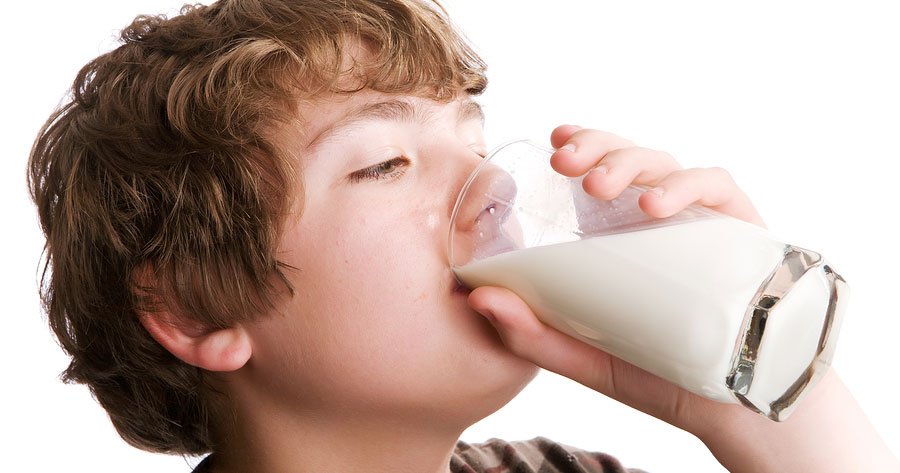
A new study has found that when kids consume high levels of dairy, they develop greater bone density and more bone-mineral content. The study, out of Boston University School of Medicine, followed 106 children, aged three to six, over a 12-year period. At the conclusion of the research, the children who had consumed at least two servings of dairy daily had bone mineral content 175 grams higher than those who consumed less than that. Plus, the kids who ate at least four ounces of meat or other protein a day in addition to two servings of dairy had bone-mineral content a whopping 200-grams higher than the kids who ate less dairy and meat.
The findings generated headlines announcing, for instance, that “Childhood Dairy Intake May Improve Adolescent Bone Health” (Science Daily) and “Childhood Dairy Intake Boosts Bone Health Later On,” (US News and World Report). Meanwhile, chief researcher Dr. Lynn Moore points out, “…dairy is a key source of proteins, calcium, and other micronutrients including phosphorus and vitamin D.” The implication is that kids should gulp down the moo juice so that they grow up strong, healthy, and tough.
Holy cow! I’m ready to hang it up and go out and eat an 18-ounce steak and drink a quart of milk! Or not.
What we have here is an example of how facts can be misleading. Because while it may be true that drinking lots of milk builds up bone density in kids, it’s also true that dense bones in childhood don’t necessarily equate to healthy bones as you age. Surprise, building up bone density by consuming dairy for years on end sets you up for a greater likelihood of osteoporosis later on.
In fact, there are two problems with high consumption of dairy — let alone high consumption of meat (as recommended in the study).
First, in a healthy young body, old bone material gets shed while new bone material gets built. This happens because certain cells, called osteoblasts, transport new calcium into the cells and use it to build the foundation for new bone matter. In the process of creating this bone foundation, at least half the osteoblasts die. That’s normal. However, the more calcium that comes into the bones, the more the osteoblasts must work and the more of them that die. To summarize: the greater the supply of calcium, the faster osteoblasts (your bone building cells) are destroyed. This means that over time the rate that new bone matter gets created slows down, and ultimately stops. Meanwhile, old bone matter continues to be removed. What you end up with is mineral-dense bones, riddled with holes, which make your bones very brittle. And so if you’re getting loads of calcium, whether through dairy products or through supplements, you might well have stronger bones in your younger years, but your bones will become brittle faster as you age.
The second problem with excess consumption of dairy is its high phosphorous content, which tends to make the body very acidic and thus requires a lot of minerals from the body to neutralize it. Ultimately, it takes more calcium from the body to neutralize the phosphorus in dairy than you receive from the dairy in the first place. (This is the same problem we see in heavy drinkers of cola with its high levels of phosphoric acid.) And if you’re having a large amount of meat on top of that, the problem is compounded.
So whose hypothesis is correct — the hypothesis the study sets forth saying that high consumption of dairy and meat builds strong bones, or my hypothesis, which says they don’t? The answer lies in looking down the road past childhood to the years when osteoporosis actually presents a problem. When we do that, we see that in countries where the average bone-mineral density is highest, the rate of hip fracture also is highest. As I explained in my 2006 newsletter on Osteoporosis, the countries with the highest dairy consumption (including the US) have a hip fracture rate 50 times greater than that found in countries with very low dairy consumption (such as South Africa and New Guinea)!
Bottom line: look at the forest (long-term bone fracture), not the trees (short-term bone density). The evidence is overwhelming: high dairy consumption may offer greater bone density, but it also leads to higher rates of osteoporosis and a greater likelihood of bone fracture.
:hc







Are raw milk, raw butter, and raw fermented milk products included in your response? Are you suggesting that two servings of dairy daily (because of the study you referred to) is too much?
Grace:
My position on dairy is very clear. It’s stated repeatedly throughout the site. (For example.) In essence, I believe that there are fundamental problems with all forms of dairy. However, as I have said, if you must drink milk, drink raw, unpasteurized, organic milk, if possible. Absolutely avoid milk that has added growth hormones and antibiotics. And do not drink homogenized milk. Raw milk avoids a number of the major problems associated with commercial dairy such as denatured proteins — but it doesn’t avoid all the problems. You still have high levels of phosphorus. And you still have overly high levels of calcium. The high levels of calcium do indeed create greater bone density as the studies indicate, but also create more fragile bone — as the blog above explains.
I'm wondering since you often
I’m wondering since you often point out in your blog the “evils” of commercial dairy products and also links to greater bone densisty/fracture issues in our elderly in comparison to countries that consume less of these products if you are completely separating the sedentary nature of most people in this country versus the countries used in comparison? Doesn’t the higher levels of physical activities in more agricultural/less sedentary countries have a great deal to do with their healthier bones? At least as much as the difference in dairy consumption perhaps? If you have any studies indicating a separation of causation in regards to these factors when comparing highly sedentary populations with more active populations along with their differences in dairy products I would be very interested.
Thanks!
There are no specific studies
There are no specific studies that separate out the effect of activity levels VS dairy consumption on osteoporosis rates. But there are certainly inferences we can make. In the US, you might claim that people have become more sedentary and overweight, and that might account for the increased osteoporosis rates as opposed to dairy consumption. But what about Norway, Sweden, and Finland, where fitness levels are high…and so are osteoporosis rates. What they share in common with the United States is extremely high dairy consumption. But don’t take Jon’s word for it (although many smart people realize that’s a good way to go). Check out the Physicians Committee for Responsible Medicine website. It’s run by medical doctors, and they are also very anti-dairy. Search on dairy and see for yourself. Here’s one article on dairy and bone health that you should get you started. http://www.pcrm.org/search/?cid=1202. It pretty much confirms everything Jon says about dairy and bone health.
Hi Baseline,
Hi Baseline,
Will boiling the milk kill the antibiotics?
I know there will still be multiple problems even if it does, but i would still like to know.
Thanks for your help.
Antibiotics are not actually
Antibiotics are not actually alive, so they can’t be killed. We assume that what you’re really asking is are they destroyed or rendered inactive by cooking? And the answer is that most antibiotics survive cooking. http://www.researchgate.net/publication/40147181_Stability_of_antibiotics_in_meat_during_a_simulated_high_temperature_destruction_process
Many thanks Baseline,
Many thanks Baseline,
It’s good to know even bad news 🙂
This is awesome! I am so
This is awesome! I am so concerned that my school sells milk in droves to its students. I wish I could do something about it without getting my hand slapped.
Jon your articles are insightful and eye-opening!
Thank youX3
Lula
Concerning dairy and
Concerning dairy and osteoporosis connection does that include yogurt which I make from liquid or powdered goat milk? What about using almond or rice milk? I rarely have any milk or milk products in my diet since a doctor had recommended that I not take cow’s milk but I could have goat milk/cheese, and almond or rice milk. I do have osteoporosis worse than other women may age, according to the results of any of the bone density tests.
Sounds like your doctor is on
Sounds like your doctor is on the right track, just be careful of the sugar content on some products. See Jon’s article: https://jonbarron.org/article/dairy-diet-delusions and https://jonbarron.org/article/osteoporosis